Showing posts with label restaurants. Show all posts

Thursday, April 16, 2009

Argh Argh Argh (An Especially Articulate Post)

Today I had a most aggravating foodie day. What made it so aggravating was that I’d planned in advance with some care.

First, I looked up when Passover ends, and read Wednesday. Which, of course, I took to mean sundown on Wednesday. So I made this whole plan to eat bread products and stuff on Thursday. Actually, though, it ends sundown Thursday. Not that I’m what anyone would call observant, since I eat shellfish and pork and mix milk with meat and all that. But it’s nice to make some effort once a year. Anyway, that’s one screw-up, which is my own. After that I take no blame.

Skimming one of my favorite Kyoto websites, Kyoto Foodie, I found a bunch of places in fair proximity to one another that are also easily accessible from Sam’s school. Since Sam only has half days at the moment — another annoying thing — I have to pick him up and take him for lunch. Now he adores udon noodles, as well as lots of things anyone would expect a little boy to like, such as ice cream, cake, fruit, and so on. It all clicked....

The Plan

Pick up Sam at 11:40, and catch the #206 bus up to Senbon Imadegawa. Walk a couple of blocks west, and eat at Tawaraya, a famous udon place. Sam can have his usual order — plain (kake) udon noodles with kamaboko fish cake and no sliced scallions. I’ll have the specialty of the house, nihon udon, which is a bowl with just two gigantic (in all directions) noodles. Sounds like an interesting thing to try, and the Kyoto Foodie was fairly positive about it.

Next, walk a couple of blocks due east, ending just south of Senbon Imadegawa, and eat dessert at Chibeta. This is a super-fancy ice cream shop, and so far as my various contacts have learned, it’s about the only really good one, with their own homemade ice cream and sherbet in both classic flavors and their special inventions.

Next, walk a couple blocks more, basically northeast, ending at Le Petit Mec, which two completely unconnected foodie contacts assure me makes the best bread in Kyoto. Buy a fancy loaf to eat with dinner, and if Sam is interested he can have a sweet bread of some kind.

Go home, get him changed, and then play in the park until Mommy gets home.

That was the plan.

The Reality

Picked up Sam, found that he was wearing his exercise pants, but I carefully avoided asking him why: it means he wet his pants, and discussing that leads nowhere good in the short run. As we walked to the bus stop, I explained the plan, and he was amenable.

On the bus, he told me he didn’t want udon. He wanted hamburgers instead. Uh oh. We discussed it, and he decided udon would be okay after all. Whew! The plan was still clicking.

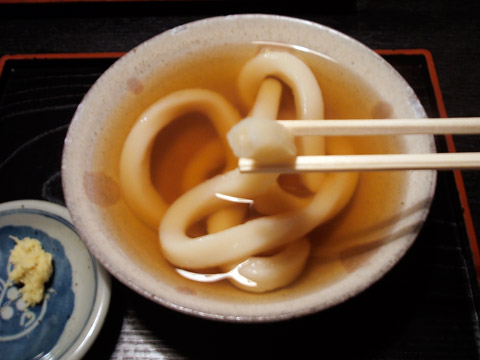
From Senbon Imadegawa, we walked to Tawaraya, which was just where the map indicated. There was something of a crush: apparently a school tour group was having lunch there. Fortunately, noodle places have quick turnover, and high school kids eat fast. We sat and waited, Sam was very good, and we got seated pretty soon. I ordered the specialty:


But this isn’t my photo. Why not?

Sorry, no nihon udon, says the guy. Eh? The specialty dish? It’s also not on the menu, which I find odd. My Japanese is too rudimentary to be sure whether they were sold out or have stopped making it, but in any event I wasn’t going to have it for lunch. Fine. I ordered cold udon with tempura for me, and for Sam the usual: plain hot udon in soup, with no scallion. No problem.

We wait. They serve the table next to us, which ordered after us. I sort of cock an eyebrow, and it becomes clear that our order has been missed. No biggie, these things happen, and fortunately Sam was behaving himself reasonably well. Our food finally arrives... and there’s scallions on Sam’s noodles. Argh! I’m not sending it back, no way. Instead, I pick every one off. Fortunately again, Sam just waits patiently, then eats without complaint.

Results: Frankly, I wasn’t very impressed. The udon place across the street from our house, where they know Sam and give him extra kamaboko (and would never, never give him scallion), is better, and definitely less crowded. When I paid the bill, I also found that Tawaraya is overpriced, albeit udon is never terribly expensive so it wasn’t a big deal. But ten-zaru udon (what I got) shouldn't cost $14, and $6 is steep for plain kake udon. I also noticed that the guy hadn’t written anything on the slip about no scallions on Sam’s noodles, which explains a lot. I still want to try the nihon udon some time, but I’m not nearly as sanguine about it now.

Okay, so now we hike to the ice cream shop. Doesn’t this stuff look delicious?


This isn’t my photo either, though. Because...

It’s closed.

You have to be kidding me. I could swear I looked it up and it isn’t supposed to be closed. There’s a workman’s ladder behind the main window. Maybe they’re closed for renovation or something? Anyway, no ice cream.

Sam was definitely annoyed about this. He mostly got over it when I made it clear that I was at least as annoyed as he was, but after all this walking and no ice cream, his fuse was clearly getting a bit short. I mean, he's not quite four yet, fair enough. So we went looking for other things, heading generally toward Le Petit Mec in hopes of salvaging things a bit — besides, they might have good cake or something.

No luck. The first coffee shop place we passed had a vast selection of coffee-flavored sweets and nothing else. The next was closed. Sam was getting tired of walking and walking, so we took the bus two stops, just past Le Petit Mec, with its beautiful bread...


Which was closed. You have GOT to be kidding me!

Fortunately we were still on the bus as we passed it, so we just didn’t get off until Horikawa, where there’s a fancy patisserie near the corner. We go in there, and Sam picks out a fruit thing that looks to me like he’s not going to like it. I ask him which I should have, and he picks a chocolate thing. I get both. But then it turns out that you can’t eat it there unless you get the cake-plus-drink set, which costs $6.50. Argh. I get ice coffee and milk, and we sit down.

Sam eats the fruit, but doesn’t like the custard, so he eats my chocolate thing. As it turns out, I don’t like the custard either, which tastes like it’s pure egg yolks and has a peculiar citrus flavor that I don’t think goes at all well with it. Heavy and sour, in short. I realize this is how they intend it to be, but I don’t like it. Ah well.

We head home, Sam dozes off on the bus and insists on being carried from the bus stop to the house, so my back starts hurting. Then he refuses to go the park and demands to watch Wall-E on TV instead. After this sequence of failures, I figure the park is probably in flames anyway, so what the heck, turn on the flick.

Aftermath

Then I check some websites.

Chibeta ice cream, closed Mondays. Why is it closed today? No idea.

Le Petit Mec bakery, closed... can that be right? It’s closed Monday through Thursday? How can they possibly run a business like that, weekends only? Weird.

Final tally: $33 for two servings of so-so udon and fancy but (to my taste) not great cake, getting and eating which took a total of about three hours.

Argh argh argh!

Stumble Upon Toolbar

Friday, February 13, 2009

A Passable Attempt

Okay, still on the subject of hamburgers after the Big Boy Hall Of Horrors, to say nothing of the Mos Burger Visitation Of Evil, the other day Sam decided he wanted a hamburger. (For Japanese readers, a reminder: that's a hamburger, not a hanbagu -- see the Big Boy post.)

See, I got fed up, and then I spotted a sale on cheap-o shaved beef for sukiyaki. I bought a kilo, brought it home, and spent 20 minutes with a big, heavy knife mincing it fine by hand. I made patties, we bought decent rolls and an acceptable couple of tomatoes, and the result was the best burger we've had in Japan. Sam loved it... and decided he wanted another one in a few days. Sale wasn't going, so that'd be expensive. Besides, I didn't have the time or inclination to spend half an hour mucking about with a whacking great knife.

So we tried another Japanese chain: Lotteria.

My basic opinion: surprisingly decent, functional hamburgers. But don't get fancy.

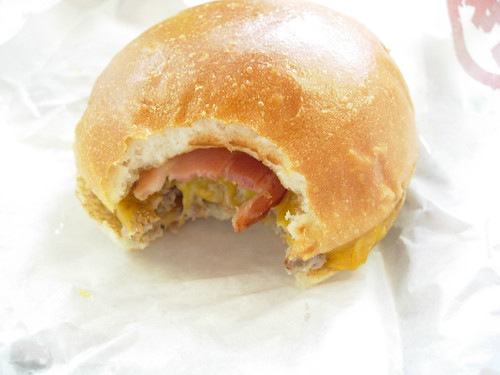
On this first go-round, I had a bacon-cheeseburger. Decent, but teeny, and the bacon of course is not cooked thoroughly, and the cheese is some sort of liquid gloop.
DSCN4235
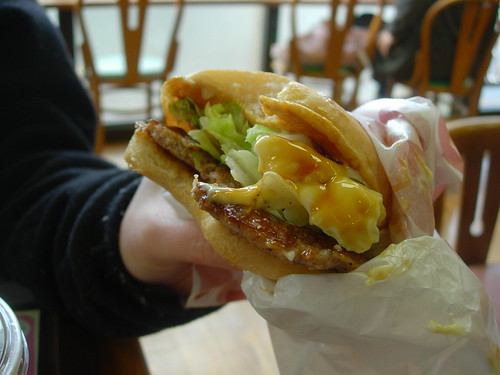
The wife had a teriyaki thingy, which she said was fine but looks very dubious to me.
DSCN4237
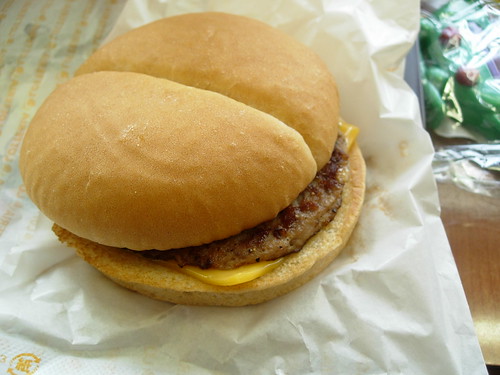
Sam had a basic cheeseburger, which was the right choice.
DSCN4241
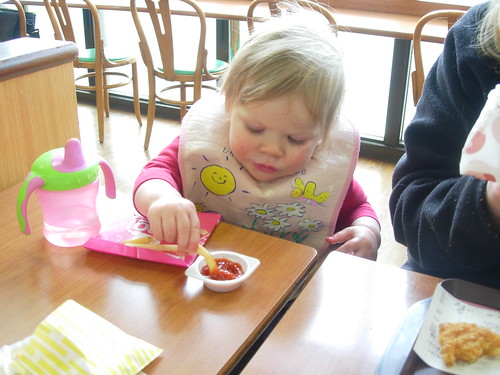
Maia was given a deep-fried rice ball, but she mostly ate fries and ketchup instead, which I think was the right choice.
DSCN4238
And then she drank the ketchup...
DSCN4243
...with predictable results...
DSCN4245
Since these photos were taken, I tried Lotteria's "straight cheeseburger." YES. That is the correct choice: go straight. Keep it simple. It had lettuce, onion, tomato, pickle, and ketchup, together with a functional fast-food burger (way better than McDonald's, for example), basic plastic cheese, and an acceptable plain bun. It looked surprisingly like the ad copy here.

So far, this is the best burger in Japan... except for me hand-mincing and going nuts, which was fabulous but expensive and time-consuming.

On the subject of homemade burgers, there are those who would tell you that it would be much, much better if I'd used wagyu beef, but it would cost a fortune and I'd have to start with about 1/2 pound per patty because so much of it would render out -- it's mostly fat, you know. Next time there's a sale, maybe I'll blog the process -- fun with knives!

Anyway, Lotteria gets a (somewhat surprising) thumbs up.

Stumble Upon Toolbar

Wednesday, January 21, 2009

Not Quite Like Home

I happened to wander out a bit west of our house — not my usual haunts — and along the way lost track of time. I found myself in need of lunch at 1:45, the problem being that most restaurants stop taking lunch orders at 1:30. But I spotted a Bob’s Big Boy, and thought, “well, I might was well check it out for Sam’s benefit.” I figured it would be nice for him to get a hamburger and fries sort of thing, but thought it’d be best if I made sure the hamburgers weren’t completely appalling.

Now here at this website, you can see the menu for Big Boy in the western part of Japan; the east part (which includes Tokyo) isn’t especially different. If you scroll down and click on a page of the menu, you can see it nice and big.

Notice something? Like, something missing?

That’s right: no hamburgers. This is Big Boy, which on its American page describes its “signature” sandwich like this:
THE BIG BOY® COMBINATION
The Original Double-Decker Hamburger
Five ounces of delicious 100% pure ground beef in two patties with American cheese, lettuce and our famous Big Boy special sauce on a sesame seed bun.
Served with French fries and cole slaw.
This sandwich, the Big Boy Sandwich, even gets discussion in a Wikipedia article about the chain. And in a Calvin Trillin article collected in his Tummy Trilogy, we learn that there are even people who claim that this burger is the best in America — though you have to go to the Burbank location, and get extra onions.

Japanese Big Boy has no hamburgers at all.

Well, let me be accurate. They have hanbagu but not hanbaga. Hanbagu is a bun-less hamburger, ground extremely fine, served with sauce. Hanbaga is a hamburger, i.e. ground beef on a bun. Japanese Big Boy also has various other kinds of meat: sliced steak (like London Broil, sort of), steak (but not very good), and a range of different sauces.

There’s also a salad bar, which was not really more or less dubious than what I’m familiar with in America, albeit the choice of dressings was different (sesame miso?).

Soup selection was corn, vegetable, or French onion. All the Japanese I saw of course got the corn soup, which they love; the onion was terrible — thin-flavored, having no noticeable beef stock in it. You’d think a place that serves that much beef ought to be able to use the scraps to make a respectable beef stock, but apparently not.

Oh — and no fries. You get about five baked potato wedges with your hanbagu, and a single broccoli floret to make it a complete meal. Choice of rice or rolls.

But I cannot get over this: Big Boy doesn’t serve burgers? What’s up with that? It’s not exactly difficult.

If you cook hanbagu, you can cook hanbaga. If you serve rolls, you can put a burger on one. If you have a salad bar, you can put on lettuce, tomato, and onion. Ketchup is very popular. Cheese hanbagu are on the menu, so a cheeseburger is also possible. And no self-respecting Japanese family restaurant doesn’t have buckets of mayo, from which to make Bob’s Special Sauce (which is basically Russian dressing), as well as cole slaw from the ever-popular range of cabbages. Fried things — shrimp, for example — are on the menu, making fries easy. So you should be able to knock out the Big Boy Combination, and any of the other classic Big Boy hamburger sandwiches, without breaking a sweat or changing your cooking line.

For the convenience of anybody who works for Big Boy Japan, here are two pictures to compare. This is a hanbagu:


This is a hamburger:


Got it? Thank you.

While I’m at it, let me point out that they don’t serve any sandwiches: it’s not just hamburgers.

Now I’m not a huge Big Boy fan or anything, but I figured it was a reliable place to get a burger. I hereby protest: this is wrong.

(Of course, what it tells you is that apparently Japanese people do not on the whole like hamburgers, which I suppose explains the success of Mos Burger.)

Chocolate Weirdness
On the way home, Sam spotted another little boy who was eating a chocolate bar. He of course demanded (actually he asked politely, but with a kid his age a polite request is backed by the threat of a tantrum) a chocolate bar of his own. At Family Mart (one of many huge chains of convenience stores) he picked out this:


A Crunky Bar. Sort of like Nestle Crunch, but the crunchies are a bit salty, which is not bad.

I find the name peculiar. It looks like a mis-transcription of an L as an R, but that would make a Clunky bar, which is presumably not the idea. My wife, who says this is a relatively old product, thinks it’s a combination of “chunky” and “crunchy.” I suppose that makes sense: if you did it the other way around, you’d have a Chunchy bar, which is even less appetizing than Crunky.

But I’m sorry, “Crunky” does not work for me as the name of a food. Is that just me?

Stumble Upon Toolbar

Friday, December 26, 2008

Kichisen Kaiseki Dinner

Christmas Eve is my wife’s birthday, so we decided to go for kaiseki again. We arranged a babysitter for the little monsters, and called Kichisen for a reservation.

Kichisen was recommended to us by the Kyoto Foodies as the best traditional-style kaiseki in Kyoto. We were more than a little worried about the reservation, since we were calling just a couple of days in advance for dinner on one of Japan’s top date nights, at an amazingly celebrated restaurant whose chef beat Morimoto Masaharu on the original Japanese Iron Chef program — no mean feat, especially considering he won unanimously against Morimoto, who almost never lost. In the event, we called, and they said no problem, see you then.

Kichisen, known also as Kisen, is in Shimogamo, which is a triangular area of northern Kyoto defined by the two big streams that join to form the Kamogawa river. The restaurant is on the southwest corner of Shimogamo Shrine, an old (technically older than Kyoto itself, in fact) and picturesque shrine with lots of grounds that you can see from well down the Kamogawa. The doorway could be anything old-fashioned, really: a big house, a ryokan, anything. But it’s a restaurant.

We go in, slip off our shoes, and are led immediately to the right, into a little room with a bar and a stone floor. We’re given straw slippers to wear from the door to the bar, and I have some trouble putting them on because my feet are big and besides I’m wearing socks, the latter making it tricky to get the sandal thong between my toes. But the distance is about six feet, so it hardly matters. A burly man with a widow’s peak, wearing a white gi top — like a martial arts uniform — took my coat and folded it neatly on the shelf behind us. He also gave my wife a blanket to keep her legs warm, which is a common routine at nice places in the winter. We sat.

For Openers
The burly man went behind the bar and the various other attendants and such vanished. It was just us and him. After handing us hot towels, he promptly gave us these little dishes filled with hot dashi sprinkled with toasted rice (genmai, like in genmai-cha). Pleasant, warming, and stimulating the appetite.
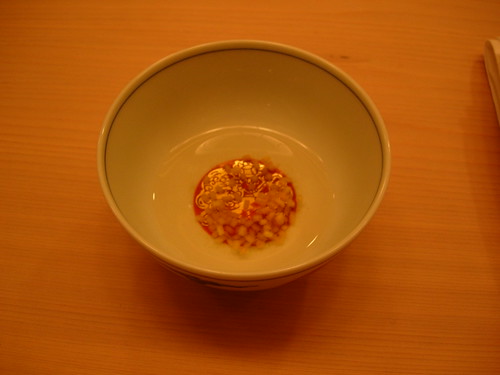
Dashi with genmai
He also checked that we spoke Japanese — me, no, but my wife certainly does — and then asked whether there was anything we don’t like to eat. Nope, we eat everything, no worries. (I wasn’t going to mention the one Japanese favorite I almost always dislike, which is boiled or simmered daikon, because I think he would have been well within his rights to chuck me out. It would be sort of like going to a high-end Italian place and saying you can’t stand garlic, cheese, tomatoes, or pasta. Not that daikon dominates Japanese food, any more than that little list dominates good Italian cooking, but it’s a constant presence. More about this later.)

On to the first course, presented in these cute little dishes, on top of this piece of calligraphy. He explained that we’re leaving the year of the Rat and entering that of the Cow, so in late December we get both. The calligraphy was, as I understand it, a poem with very heavy allusions to Sen no Rikyu, the inventor of tea ceremony and thus the ultimate forefather of kaiseki.
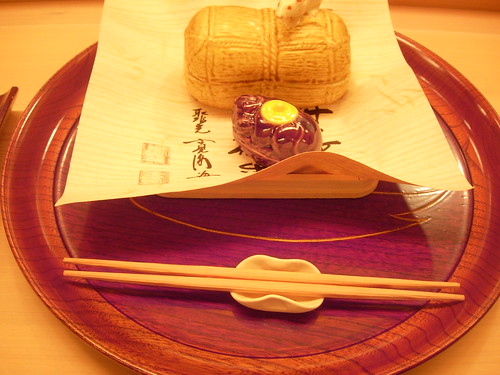
Hassun covered
Inside the dishes, a range of things, not all of which we can identify. From left, clockwise, in the top container: Sliced duck squares sandwiched around a thin slice of sweet simmered something, possibly some kind of sweet turnip or maybe fruit. A cube of some kind of tofu cake, I think with gingko nuts in it. Broccolini simmered in what I believe was Tosa-zu (Tosa-style vinegar), seasoned with ground toasted sesame. A teeny-tiny piece of a stick of super-mild pickled ginger. In the very front right, where you can't see them, were two little long-simmered whole fish, to be eaten whole. In the lower dish were two things: yellow stuff and green stuff. My wife thinks the yellow stuff might have been prepared persimmon of some kind; I think she's wrong, but I can't offer any better guesses. The green stuff... no idea. Maybe some sort of bamboo shoot, but that's out of season, so who knows?
Hassun

On With The Show

We continued with a clear soup: dashi, shiitake cap, teeny baby bok choy, and a cube made primarily of Ise-ebi (spiny lobster), garnished (aromatized) with julienned yuzu zest. The chef instructed us to taste the dashi first by itself, then drop the yuzu in the front and taste again, and then eat the things in the soup in between sips of broth. That business with the yuzu creates the effect called “aromatized”: the dashi remains dashi (and very good dashi at that!), but the yuzu adds an intense acid-floral aroma. My sense was that these two strongly different flavors are supposed to create a sort of frame for the things in the soup, but I could well be misunderstanding. In any case, it was nice finally to have a classic suimono clear soup made by somebody who’s into it, and I must say that it's lovely when done right.
Suimono
Next up, otsukuri, which is the local term for what Tokyo-ites call sashimi. It didn’t come up, but it was becoming clear that if we had asked the chef, he would have told us that the proper word is “otsukuri,” although of course a lot of hicks from polluted holes like Tokyo use silly terms like “sashimi.” He is, as you’ll have figured out, pretty proud of Kyoto — “best food in the world.” He also doesn’t like food outside Japan, and told us about how he ate uni (sea urchin) in New York; his host apparently said it was very good, so he was polite, but actually he thought it was old and nasty. Tokyo, he doesn't like much either -- the air is foul and you can't breathe. The only place he seemed to have anything nice to say (other than Kyoto) was Finland, where he liked the fact that the air is clean. Back to food, he also didn’t like the bread in France, but we had to disagree (equally politely) about that one! In any event, the uni question came up because of the otsukuri he served.
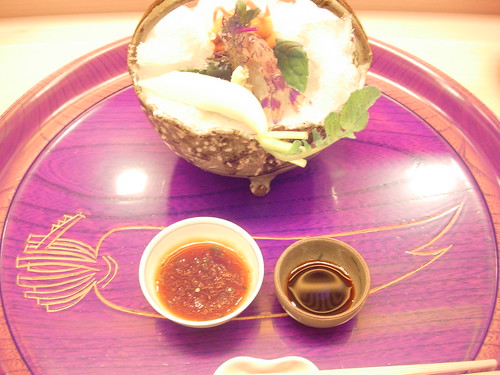
Sashimi
The photo is too bright because of the shaved ice, I’m afraid, but you can still see what we ate. Dead-center is a raw shrimp, behind which is a pile of uni. Mmmm, I love uni. In the front is a baby daikon, and then the whole thing is garnished with little edible nibbles. He gave us some sheets of toasted nori seaweed and instructed us to wrap the uni in it, then dip lightly in soy. The shrimp and daikon got the ponzu with grated daikon and so on. Personally, I’m not a fan of raw shrimp, and now I know for sure that I just don’t like it all that much: if I didn’t like it at Kichisen, I don’t like it! But the uni was just right: seafood butter with a little texture, and with the dab of soy and the crunchy nori it was spectacular.
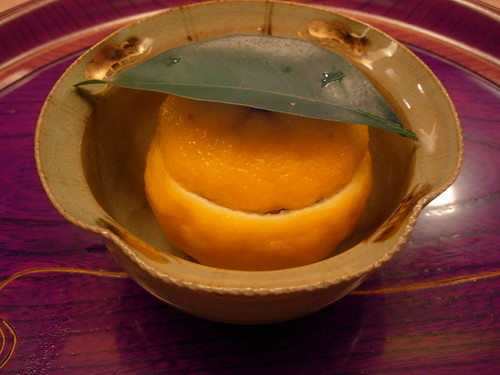
Yuzu-steamed rice covered
Then a hollowed-out yuzu steamed with rice, little dried berries, and tiny fluted potatoes. He encouraged me to photograph it both as presented (with the lid) and opened up. We didn’t quite figure out what the berries were. I thought they might be kuromame, black beans, but he said they were berries and gave the name — which my wife didn’t happen to know off the top of her head. It’s a rather specialized vocabulary, and probably he was using a regional dialect term anyway. They had a very mild taste and a little bit of crunch. The potatoes didn’t taste like all that much, really, but the rice and yuzu combination was warming and friendly after the icy otsukuri. Clearly part of the idea here is an alternation between snow and warmth, giving you the best things of December.
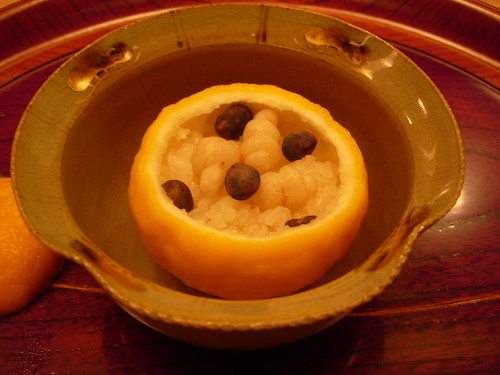
Yuzu-steamed rice

Climax

For me, the climactic moment — the best dish of all — was this cup. Inside was fugu, the much-discussed poison blowfish, covered with chopped thin negi (asatsuki) and a sauce of ponzu and other things I couldn’t quite place. I’d had things flavored with fugu before, but here we really got to taste what it’s like: mild, creamy, and rich. (My wife thinks that this might not have just been regular flesh, but obviously it can't be the liver, as the fugu liver is where the tetrodotoxin is, and if you eat more than a trace amount, you die. I think it can't have been organs of any kind, as I think then you'd have had some trace tetrodotoxin and gotten numb lips, which some fugu crazies enjoy.) In any event, it was extraordinary to me. The texture was reminiscent of uni, but firmer. The flavor was very sweet as fish go, and yet ocean brine-y. The only way I can explain it, I guess, is that this fugu was for me everything otsukuri and sushi really ought to be, but never is.
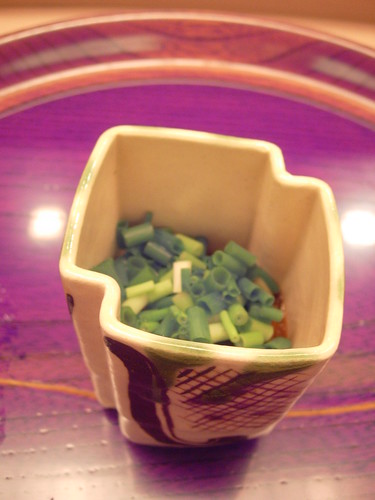
Fugu
Back to the snows: crab legs split and served in shaved ice. The little dish in front contained the “mustard,” what the Japanese call the miso, i.e. the liver and fat of the crab. It was mixed with a little soy, dashi, ginger, and a little bit of some kind of citrus juice — I think sudachi, but I wouldn’t swear to it. We discussed this with him, while we drank off the dish — it’s for dipping, but it’s too good to let it go to waste. The usual way to serve cold steamed crab in the West is with something like a mayonnaise, which is nice, but my wife and I agreed that you really need something more acid to cut the richness. This combination was lovely: the richness was from the crab, in the form of its mustard; the acid comes from the citrus; and the whole thing is deepened with the Japanese standards of dashi and a very small amount of soy. The chef mentioned that the crab was from the Japan Sea, not Hokkaido, and that the ginger is Japanese, not imported, both of which make it enormously more expensive; his point wasn't that it was expensive, I think, but that he insists on these ingredients because (a) they're local, and (b) they taste better. [Admittedly, I think he probably thinks "local" and "tastes better" pretty much imply one another, but he wouldn't serve local ingredients that didn't taste good, whatever they cost.]
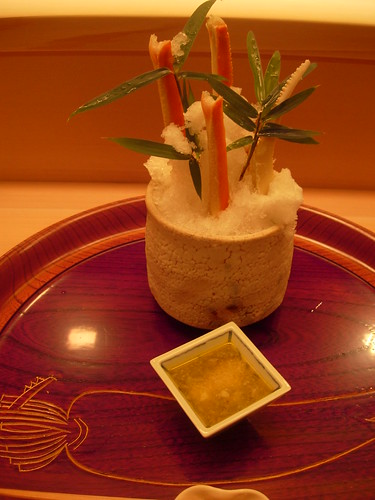
Crab
Back home, I will have to try something like this with lobster or softshell crab. I’ll pass on the soy and dashi, which don’t speak to me the way they do for the Japanese. But instead of just drawn butter and lemon, or mayonnaise, why not use the mustard or tomalley, a small squeeze of seasonal citrus, and then a teeny drop of white wine? Maybe just a whisper of finely-minced shallot too.

Now the next thing was much, much better than I think it had any right to be. Steamed or perhaps poached turnip on top of a little pile of amadai (tilefish, or Japanese branquillo), with grated daikon and minced negi, some gingko nuts, a little ball of mild wasabi on the top, all in a puddle of warm jellied dashi aromatized with toasted rice. Described that way, I would have assumed I’d hate this. But first of all it was made so well, and the flavors balanced so perfectly, that you really couldn’t dislike it. And coming after the snowy crab, once again the little dish of warmth was delightful. I would not want this dish by itself, though I wouldn’t complain, but in this context it was wonderful.
Kabu and Amadai
Next up, soba and then tempura. The soba came as you see it: a mound on a little wooden dish, in a basket lined with leaves, with a classic dipping sauce... or so we assumed. We were told that when we’d finished the soba, we’d have tempura with the same sauce. Now I will say that this soba must have been pure buckwheat flour, or nearly so, and was firmer and more flavorful than soba normally is. Other than that, it was mostly a sort of palate-cleanser: going from the squodgy turnip and amadai straight to rich tempura would be problematic.
Soba
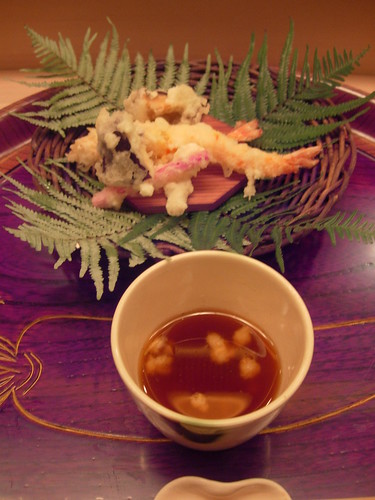
Then came a basket of freshly-fried tempura, and we picked out equal portions, as you see here. Two shrimp, two quartered shiitake caps, a short stalk of pickled ginger, and a bit of gobo (burdock) stalk. I am not normally a fan of gobo, but this was terrific. And the shrimp were moist and creamy in a way that tempura, even good tempura, normally isn’t. All in all, the best tempura I’ve ever had, though I can’t say I’ve had all that much good stuff.
Tempura
I was very proud of myself here. As we ate, I kept thinking that there was something odd about the sauce. On the one hand, this was your basic tentsuyu: mirin, dashi, and soy, with grated daikon mixed in. But it was slightly, yet distinctly, spicy. I asked what it was, and the chef said it was daikon. I insisted: what’s making is it spicy? He seemed quite pleased, and told me that it’s not normal daikon but rather karashi-daikon, which is indeed slightly spicy. He also called one of the other chefs in the kitchen to bring him a karashi-daikon to show me. It looked like a small kabu turnip: round, white, and about the size of a small baby’s fist. I think he was pleased because here was a foreigner who could identify the difference between types of daikon even when mixed into tentsuyu. I was, as I say, pretty proud of myself. (Thing is, karashi-daikon I consider a major improvement on regular daikon, having the sweetness of daikon, the sharpness of red radish, and none of that old turnip flavor I associate with daikon and which is why I dislike boiled daikon. I’m going to go looking for karashi-daikon at Nishiki market.)

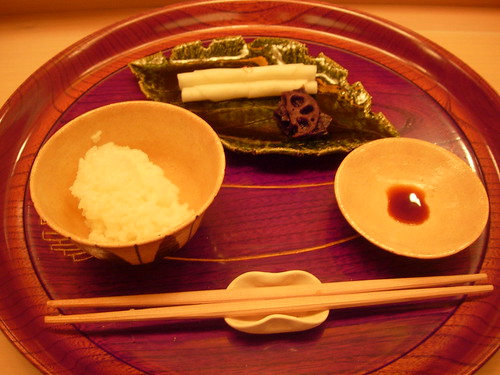
The last major course was rice and pickles. The pickles were the round "thousand-slice" daikon pickles (senmaizuke) that are a Kyoto winter specialty, plus some preparation of lotus root that I couldn’t place. The rice is apparently this super-fancy rice grown just for him, and he asked if we could tell that it’s so good. I answered, honestly, that I could tell either that it’s extremely good rice or very well made, but beyond that I’m lost; since this rice fitted both descriptions, I’m afraid its spectacular qualities were largely wasted on me. He seemed mollified, though.
Rice and Pickles

Closing Acts
For dessert, this beautiful dish. It’s a California citrus of some kind, which I still can’t place: it’s like a very tart orange with a green peel, but I don’t think it was actually underripe. Perhaps a green grapefruit? Anyway, he’d hollowed it out and made a medium-stiff jelly with the juice, which set back in the shell — no mean trick, this. Over the top, a fine web of lightly-cooked caramel, garnished with a shaving of caramelized peel. The sauce was, I think, dark-caramelized sugar, citrus juice, and just enough water (I’d guess) to keep it fairly thin. You put the web on the jelly, pour sauce over the top, and then dig in with a spoon.
Dessert 1 Citrus Jelly
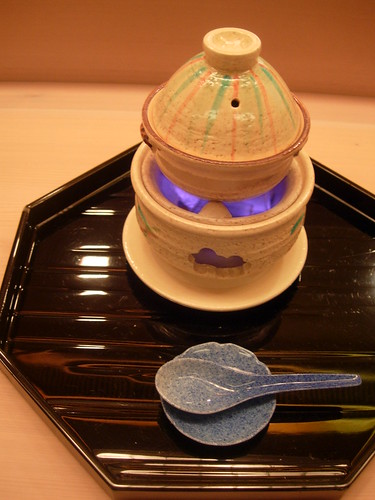
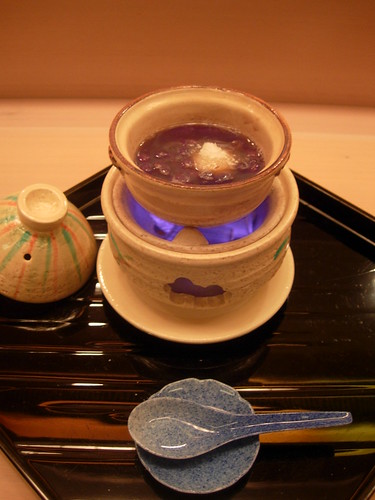
Of course, because this was garnished with snow again, and was quite bitter-sour, we finished it up thinking, “hmm, kind of cold and bitter here.” So on came the second dessert: zensai, as they call it here. Red beans and mochi simmering in a little cup.

It came like this, with a lid on, and under it you can see the actual dessert.
Dessert 2 Zensai
In the bottom was a little mound of hot charcoal, which kept the mixture bubbling and very close to too hot to eat. My wife actually burned her tongue a bit, but she’s kind of a klutz that way.
Dessert 2 Zensai uncovered
I didn’t get photographs here, but we had another demonstration of the brilliance of kaiseki at its best. We’d finished the citrus thinking we wanted something hot and sweet, and we got it — but it was too hot, and too sweet. So what then? Well, then came bowls with a small amount of macha, powdered green tea, which is extremely bitter because you’re actually drinking the leaves as well as their infusion. Wonderful... but now kind of bitter in the mouth, albeit warm? Oh, yes, then came just a little mild tea to finish up. So each time you finished one thing, it took you just a bit too far in one direction, and then you got something that met this need but pushed a little too far in another direction, and so on. Fantastic, honestly.

The Chef's Table
While we drank our final tea, the chef chatted with us. As we’d long since realized, this burly man in the white gi was the chef, Tanigawa Yoshimi. The guy who beat Morimoto hollow on Iron Chef. The guy who seems to be one of the architects of the kyo-ryori movement against the over-elegance of kaiseki as such. (As I understand it, the point is that Tanigawa thinks much of kaiseki has lost touch with the rustic elegance that was so central for Sen no Rikyu’s chanoyu; it’s become sophisticated in a more urban, courtly style. His kyo-ryori emphasizes a greater simplicity, but as you can see, that’s not “down-home cooking” or anything like that, just a renovation of the aesthetic.) In any event, the guy who mopped my wife’s dish when she slopped on it (told you she’s a bit of a klutz!) was one of the most celebrated chefs in this whole cuisine.
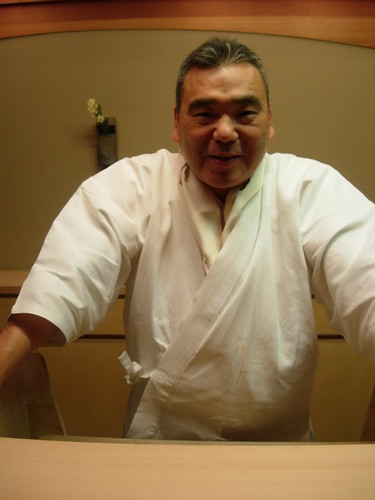
Chef Tanigawa Yoshimi
You may recall that Chef Murata served us most of our food at Roan Kikunoi, and now Chef Tanigawa served us at Kichisen. This isn’t because we’re special: that’s how kaiseki (or kyo-ryori) works. Murata was less attentive, because he had three parties at the bar; Tanigawa was with us almost the entire time, though he didn’t stand over us, because we were alone at the bar.

By way of contrast, my wife gave me this link to an article in the New York Times. It's about a new fad, dining at the "chef's table." The idea is that when you go to some place like Craft or Blue Ginger or wherever, a place where the chef is more or less a celebrity (as Tom Colicchio and Ming Tsai are, at these restaurants), they actually cook your food. That's right, if you make a reservation weeks and weeks in advance, and pay extra, you too can have the special exclusive experience of having the chef of a fancy restaurant actually cook. Isn't that grand? The NYT reviewer seems underwhelmed by the cooking, but he doesn't criticize the concept.

Thing is, this is absolutely normal in kaiseki. If you go to Tanigawa's restaurant, or Murata's, you know that they're cooking. Where else would they be? Not that Tanigawa made every part of every dish we ate -- far from it. But every bit was done under his watchful eye, finished by his hands or with him standing over (and possibly yelling at) the guy doing the finishing, and served to us from his hands (actually two things were served by apprentices, but Tanigawa was a constant presence). And this isn't because we're special: that's how this cuisine is done.

In this situation, Chef Tanigawa really could have gotten away with murder: he could have tried to impress us with his wonderfulness, or awe us, or whatever. But that's contrary to the aesthetics he believes in. He wants us to eat and enjoy, and he works very hard indeed to make that happen -- but the hard part of that work is hidden, so as not to disturb us. He wants to entertain us, but he makes minimal use of his celebrity to do it. He did mention the Iron Chef thing, but actually the point was that it gave him an opportunity to ensure that we went home with a copy of the DVD of the show. He also put in a box of his own chirimen, in this case chewy little teeny semi-dry fish seasoned strongly with sansho. Why? Well, you want your guests to leave without that feeling that it's all just over, the sort of post-dining letdown, so you give them some gifties. The fact that he's a culinary celebrity helps him to do this, but it's not something he made a big deal about. My wife asked him, "What was doing Iron Chef like?" His complete response: "Shindoi" (tiring). As to Murata, whose book is apparently something of a sensation among Western cooks lately, and is on TV a lot, and so on -- he just never mentioned any of this, nor in fact made it clear who he was.

There's a kind of high elegance to that. You're being served dinner by a famous celebrity chef, but he's too busy focusing on you and your meal to make a fuss about himself. You're what matters, not him. Isn't that how it should be?

Conclusion
My conclusion? I really like kaiseki, kyo-ryori, whatever. It’s brilliant, elegant, sophisticated, and just beautifully constructed to produce a fabulous dining experience. Perhaps most importantly, it is completely unpretentious. No arrogance, superiority, or whatever. He just did what he did, and wanted us to enjoy it as best we could, and his explanations and so forth were clearly aimed at helping us get more out of it. But I don’t think he thought we needed helping along: he’d have done the same thing with any diners who seemed interested, pitched to the appropriate level.

So, after perhaps the best meal of my life, I find myself wondering: could kaiseki be done outside Japan? Arguably it doesn’t really exist outside the Kyoto area, but that’s not what I mean. I mean, could the whole approach, the conception of the cuisine, be reformulated elsewhere? At some point I’ll jabber about that here on this blog — you’ll be the first to be truly bored by it!

Stumble Upon Toolbar

Monday, December 15, 2008

Seven Lucky Gods

I got a chance to try another place for tantan men today. Unfortunately, it was very cold this morning, so I switched coats, and the result is that I didn’t have my camera. Argh. Oh well, the internet is a wonderful thing.

Today was Seven Lucky Gods (七福神), at the northeast corner of Horikawa-Oike. It’s a classic ramen joint: long counter, a couple of tables, open kitchen, and so on. Their specialties are a fish-broth ramen and their Ninth Street Scallion Tantan Men (kyujo-negi tantan men 九条ねぎ坦々麺).

Sam had miso ramen with roasted pork (chashu) and medium-boiled eggs, no negi. I ordered a batch of gyoza. And, of course, I had the tantan men.

The Rundown
All in all, a satisfying if rather strange approach to this dish. Here's a photo I found on-line (fortunately, all Japanese are apparently trained from the cradle to photograph their food and post it for public discussion):
The stock was strong and effective, with a definite pork flavor. The noodles were just about right in terms of richness, egg flavor, and bounce. And of course the 9th Street Scallions were good: that’s one of the kyo-yasai, the special Kyoto vegetables everyone’s on about these days.

But otherwise, the dish was very odd.

No ground pork topping: roasted pork instead. Minimal sesame flavor. A lot of togarashi (red chile), and very little rayu (spicy chile oil). No Sichuan peppercorn. And I’m pretty sure there was some sweet miso in there as well.

What's really peculiar is that the sign says that the kyujo-negi are certified to be really kyujo-negi by the Kyoto Agricultural Council, and that the rayu is special stuff from 山田油店, which appears to be in Saitama, north of Tokyo. But having made this production about it, there wasn't actually all that much negi and there sure as heck wasn't a lot of rayu.

By The Way
Sam adored his miso ramen. He’s no great judge, but certainly he was down on Ginza Shisen, as was I. I thought it was good miso ramen, but I admit I don’t have a whole lot of experience with that dish. This looks a good deal like what he ate -- again, an image I found on-line.

The bowlful Sam ate was a little different, in that it had no negi: Sam hates negi, and in fact all types of onions, in every form we have yet tried. And he has a surprising ability to detect them lurking behind other flavors, whatever they might look like.

The gyoza were classic Japanese gyoza: thin, under-flavored, thin-skinned. Not excellent, as they lacked the crunchy brownness of perfect gyoza. But well made, with none of the peculiar off cabbage flavors of Ginza Shisen. One thing I thought odd was the sauce with which they served these gyoza, which I couldn’t place at all (although eating tantanmen at the same time makes it a little difficult to identify subtle things without pretty strong cues).

I would bet that their fish ramen, and their more basic ramen offerings, would be good.

Assessment
In essence, this is tantanmen as another form of ramen, an approach I think is perfectly legitimate but which I’ve never seen taken to this extreme. The only way in which this bowl differed from any other miso ramen was in the replacement of sesame paste for some of the miso, and the admixture of some spicy stuff (togarashi and, according to the sign at least, rayu).

I would definitely recommend this to someone who’s a big fan of miso ramen and is looking for something a little different. As tantanmen per se, however, it’s very peculiar.

All of which makes it difficult to rate this entry.

As a dish, assessed on its own merits, I give it a 6/10: solid, tasty, well executed, but nothing spectacular.

As tantanmen, assessed with reference to that dish, I give it a 5/10: very tasty, but so outside the normal range that it gets some demerits.

I now think I should have rated Ginza Shisen lower, but them's the breaks.

Stumble Upon Toolbar

Wednesday, December 10, 2008

Tantan Men: Preliminary Tasting

My passing remark about how I intend to do a comparison tasting of a lot of different bowls of tantanmen in Kyoto has already prompted some slavering comments, so let’s get cracking.

Before the tasting begins, though, let’s consider what tantan men actually is.

Origins: Dan Dan Mian
Dandan mian
This is a Sichuan dish that is, at base, extremely simple. Take hot, fresh egg noodles. Toss with lots of chopped scallion, chili sauce (doubanjiang, for example), soy sauce, chili oil (la-yu), sesame paste, and usually some ground-up Sichuan peppercorns. Often some pickled vegetables are added. Carry it to work in a lunchbox, where the residual heat will bring out the flavors.

Made this way, the dish is a marvelous demonstration of the Sichuan penchant for simple, rustic, yet deep and complex dishes. Every major flavor is here: sweet (sesame paste), sour (in the sauce), salty (soy), bitter (raw scallion). In addition, you have two contested flavors: spicy (chilies) and fatty (sesame and oil). Depending on how the ingredients are prepared, there may also be more or less umami or savory, the famous “fifth flavor.”

And yet, there is nothing additional, no gilding, no tricks. The dish is at base as subtle as an axe. But made well, it’s a dish fit for a peasant or a king.

You will often see it said that there must be ground or minced pork in the dish, and while this is now usual, it is certainly a deviation from its peasant origins. After all, meat of any kind was long a rarity for Chinese peasants, and everything else about the dish bespeaks peasant simplicity. For the same reason, it is very unlikely that the dish would be served in soup, soup being again a delicacy requiring expensive ingredients, time, and cooking fuel.

Japanese Adaptation: Tan Tan Men
Tan Tan Men
I have seen it suggested that tantan men was invented by the “father of Sichuan cuisine” in Japan, Chen Kenichi, who later turned up as Iron Chef Chinese on the original Japanese Iron Chef show. In this account, Chen took a sort of vaguely gourmet version of dandanmian — with the pork, for instance — and made it into ramen-like soup noodles.

Whether this story is actually true or not, certainly the Japanese version is precisely thus. Instead of a sauce, there is a soup consisting of a pork broth (or sometimes chicken, or both) flavored with sesame paste, chili sauce, soy, and chili oil (rayu). Noodles are added, and then topped with minced pork, chopped scallions, sesame seeds, and some kind of vegetable — usually bok choy (chingensai), usually not pickled. In some cases, black sesame (paste and seeds) may be used in place of the usual white. More chili oil is commonly added as a pretty red garnish.

Now I like both the Sichuan version and the Japanese one, and a number of the many variations on the theme that I’ve tried. So, as noted in an earlier post, I have decided that it is my bounden duty to try a ridiculous number of different restaurants’ offerings of tantan men and tell you what I think of them, ultimately leading to a sort of guide.

To my mind, this makes more sense than a guide to ramen in Kyoto. I mean, ramen is all very well, but first of all, which style of ramen? And second, ramen is much too Japanese for me, and never nearly spicy or complicated enough. It’s fine, I guess, but my palate lies much closer to Sichuan and Hunan.

Before finally getting on to specific examples, let’s run through the four basics:

Stock — normally pork or pork-and-chicken. You should be able to tell.
Flavor Base — sesame, chili sauce, soy, and usually chili oil
Noodles — bouncy egg noodles, as in ramen
Topping — minced pork cooked with garlic, ginger, and Sichuan peppercorns until caramelized; green vegetable, pickled or otherwise, usually bok choy; chopped scallion; often sesame seeds; sometimes toasted whole dry chilies and/or toasted Sichuan peppercorns; often a drizzle of chili oil

Each of these basic four components should stand up for itself and be worth eating.

So without further ado....

Ginza Shisen (銀座四川)
Tan Tan Men
In the Porta underground shopping arcade, by Kyoto Station. Here is a Japanese website with links and some reviews and such, giving it an overall 5 out of 5: high marks indeed!

Just goes to show you what trust you can put in websites like that. All told, a pretty mediocre bowl, but so typical that I’ll use it as a first basic discussion.

Stock: Weak, thin, and lacking character. I’d guess it was pork stock, but it tasted mostly of salt. No depth of flavor to stand up to the other ingredients.

Flavor Base: Somebody tell these guys about chili sauce (doubanjiang), because apparently they forgot it. Thus the flavoring was sweet and rich, and rather salty, but lacked both the fire and the complex sourness of chili sauce. As a result it seemed, again, thin and lacking character.

Noodles: Respectable ramen noodles, but a little too eggy for my taste. This would have been perfect for the dish, actually, if the other things had stood up to it — if your noodles are too light they ought to be overpowered.

Toppings: Minced pork appeared to be simply stir-fried without any significant flavoring, and certainly wasn’t caramelized; bok choy was respectable; minimal scallion; no sesame seeds; and finally a couple drops of chili oil off to the side as a sort of ironic comment on the lack of flavor here. No hint of Sichuan peppercorns anywhere.

The thing is, I’d currently give this about a 4 out of 10. From what I’ve said, it sounds like I’d give it a right panning, but in fact, it was well within the average range of tantan men as I’ve had it in Kyoto. Weak, thin, low on flavor, poorly balanced, and basically lacking depth or force... but that’s the way most Japanese seem to like it. Sichuan peppercorns are rare indeed, which means that the dish usually lacks the numbing-spicy special flavor that is distinctive to Sichuan.

Which, in fact, is precisely why I’m doing this little quest. I want to find tantan men made the way I think it should be, not the way they do. I mean, of all people to get Sichuan food wrong, I’d put the Japanese and the English at the top of the list: they don’t like hot spices, garlic, or robust and even brutal flavors. (Let’s not talk about what they call “curry,” okay? The really spicy-hot curries are worse, actually, because they’re just hot with no depth.)

To conclude, I noticed on the way out that more or less next to Ginza Shisen is another place that serves tantanmen, so pretty soon it’s back to Porta for another bowl.

As time goes by (sing with me!), I will post more reviews, and I will also progressively refine my own secret recipe. Ultimately I hope to develop a recipe that is as good as any in Kyoto. And if I can’t, I hope it’s because I’ve found some truly killer tantanmen.

Stumble Upon Toolbar

Friday, December 5, 2008

Lovely Chinese Lunch

I’m starting to work on an entry about Tan Tan Men (淡々面), the Japanese version of the classic Sichuan dish Dan Dan Mian. It’s a spicy bowl of noodles I love in both forms, and just about every semi-Chinese place has them at lunchtime. So I’m going around cataloguing, trying bowl after bowl of noodles, taking pictures, and so on.

But I just had to share this place.
Tan Tan Men 01
I had some trouble finding these characters, partly because they’re so stylized in the sign, but I think this place is called Sen Gō Kan (膳豪漢). A local on-line restaurant place gives the characters as 膳處漢, but I think they're misreading the middle character -- at any rate, that's not what this sign says. Admittedly, I also think I've got the middle character wrong, but it appears to be extremely obscure and I don't have really good dictionaries to hand. On the other hand, Google maps and such do give the other version. I don't care, the noren has different characters, so there. Anyway, it’s on Nishikikōji-dōri, between Muromachi-dōri and Shinmachi-dōri.

The first time we went there, I had black sesame Tan Tan Men, and my wife had the dim sum set lunch. Both were wonderful. But just when my wife was feeling pretty full, they came in and gave her one more thing: a bowl of shark’s fin noodle soup. This seemed like overkill, but it looked great, and she had a little, and I tasted it... And then the waiter comes zipping back in all apologetic: this wasn’t supposed to come with the set lunch, but was ordered by another table. My wife is equally apologetic: it’s fine if they take it, but they ought to know we’ve tasted it already. The waiter looks pretty worried, and goes off. He comes back with the manager, who says, “no, don’t worry, just eat it. No problem.” So we had a gourmet extra!

Now since then, I’ve gone back by myself several times. I always think maybe I’ll try something else, but then I can’t resist the black sesame noodles, which look like this:
Tan Tan Men 01
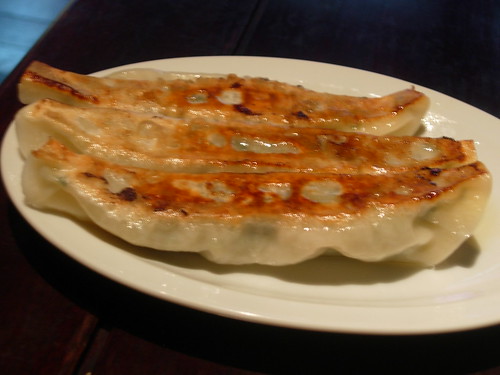
This time, I also ordered gyoza. I happened to notice that they come in two plate sizes: 3 dumplings or 6. This is odd, because usually they come about 5 or so to an order, and the price isn’t spectacularly low. So I figure, what the hey? And when they arrive, I see why:
Tan Tan Men 01
These things are huge! Unfortunately, they do have that thin skin the Japanese like, where I like them a little more robust, but at least these ones weren’t the ultra-thin paper-skinned ones that I think are silly.

Anyway, I just had to show you my lunch.

Stumble Upon Toolbar

Tuesday, October 21, 2008

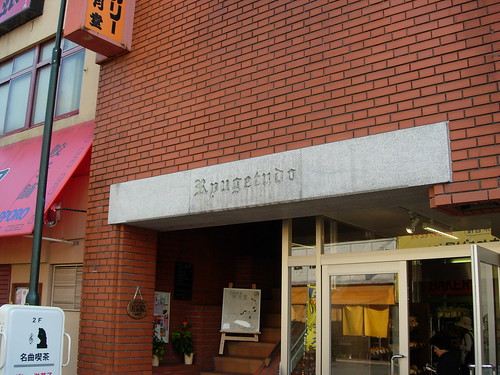
Ryugetsudo Coffee Shop (柳月堂)

Over the last couple of weeks, I’ve been wandering around looking for a good coffee shop. There are a zillion coffee shops in Kyoto, in wildly varying styles, prices, and quality. So I’ve been looking for a good one to spend several hours reading. (I’m an academic, and I’m supposed to be on sabbatical doing some research as well as enjoying myself, after all.)

After trying a bunch, I have found that I have pretty specific requirements. I used to not care much, but I guess I’m getting old. These days I want the coffee to be decent, though I’m not a nut about this. I want a quiet atmosphere, comfortable chairs, music I like or at least don’t really hate (preferably not with singing in English, which breaks into my concentration), and no great sense of pressure to order something or give up the table. Oddly enough, I have found a great many that meet every requirement except the music: usually you get your pick of J-pop, muzak, various irritating styles of mediocre American pop, or every now and again a place with a huge range that plays it all randomly. But I have also increasingly found that it is the music that makes a place impossible: for example, I found one place that is very nice in most respects, except that they play continuous 1950s American doo-wop sort of stuff, and after an hour I feel like my brain has been blenderized.
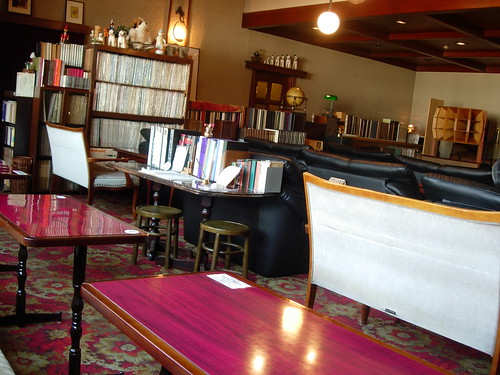
Ryugetsudo 1
So, with some reservations, I decided to check out Ryugetsudo, an old coffee shop founded in 1953 as a sort of temple to European “classical” music.

Rules Of Sound
The first thing you have to know is that this place has definite rules. No talking, no cellphones, no typing, no anything that could disturb people listening. If you buy a pastry at the bakery downstairs, you may eat it, but you must unwrap it in the hallway before you enter the main room. Everything is organized around the music.
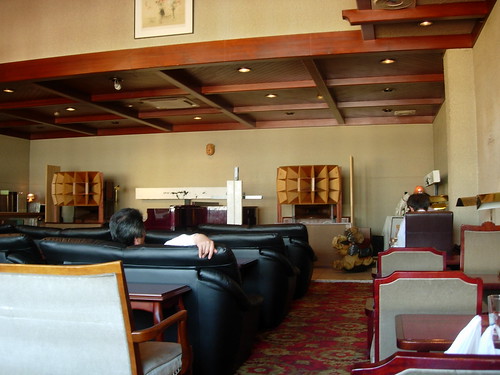
Ryugetsudo 6
This is also true visually. All the seating is arranged in rows facing a low dais with a piano, above which, to left and right, are large speakers made more attractive by some beautiful wooden things that spread the sound. Along one side are a lot of books and the huge record collection (records, as in vinyl, if you even know what that means any more!), and the books are basically reference works about music: work catalogues of major composers, reference works on opera, and so on.

If you wish, you may sit at a table in the back and pore through the four-volume handwritten catalogue in binders, organized A-Z by composer for three volumes, plus one volume for nothing but Mozart and Beethoven. Having found something you’d like to hear, you write the disc number and the album title (in Japanese katakana transcription) on the next open line in the music-paper notebook that sits open, and when they’ve played through to your selection you’ll hear it.

I said I had reservations, right? First of all, it’s quite a hike for me, up by Imadegawa Eiden train station, north of Kyoto University. No big deal, really, but irritating. Second, it’s expensive: you pay a “seat charge” of 500¥, so that your first cup of coffee is 500¥+550¥ = $10.50. If you have more coffee, the price per cup drops because you don't keep paying the seat charge, but that’s still an awful lot in my opinion. Third, I kind of get the heebie-jeebies about this kind of “temple of high art” stuff.

Anyway, I went.

Entering The Temple
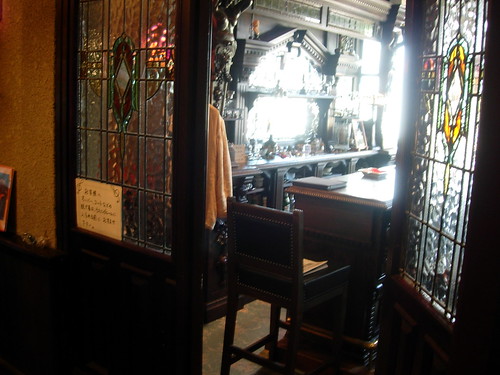
Ryugetsudo 5
My first reaction was that the room itself is surprisingly comfortable and pleasantly studious. Most of the customers were men, which amazed me; over the course of a few hours I began to realize that most of them must be Kyodai faculty: what other group of middle-aged men in suits would sit in a classical music coffee shop for two hours on a weekday afternoon reading a book? And there aren’t a lot of women, I presume because (a) they can’t talk to each other, which is what women do at coffee shops here and probably everywhere, and (b) there aren’t almost any Kyodai faculty women, which is a disgrace. I will say that walking in and hearing a warm, vibrant recording of a Mozart piano concerto was no bad thing either.
Ryugetsudo 7
My next reaction was amused enjoyment of the service staff. They are all passably pretty young women, and they wear very soft shoes (to dampen noise), tidy white blouses with black v-neck sweaters, and pleated black skirts. They look, in fact, sort of like Japanese schoolgirls grown up and wearing a young woman’s version of the same uniform. They bring coffee and water, put it down silently, bob a curtsey, and disappear silently. Nice! (Another reason, I suspect, why the clientele is primarily male: this kind of service is not especially unusual in Japan, but when combined with monastic silence it feels slightly servile in a way that is not unpleasant for a middle-aged man like me, pleasant probably for many of them, and may perhaps feel odd for younger men and for women in general. Just a guess.) The fact that they are all young and fairly pretty makes me a little suspicious that the management are deliberately aiming at their audience, but I’m not really going to argue about it: they're not ogled or harassed or anything.

My third reaction was confusion. I decided, you see, that I should take a look at the big catalogue, because I figured this was probably a pretty good place to hear Tōru Takemitsu’s music. Takemitsu (武満 徹) was the dean of Japanese composers working in a more or less “classical” idiom. So I flip through, and there he is: one work, the Requiem for String Orchestra of 1957. Eh? This predates all his really major compositions, his leap to fame and importance in the international music scene, and all that. And he was quite prolific, too! Nothing else? And how come this hand-written catalogue still lists his dates as 1930–, when he in fact died in 1996; does this mean that nobody has called for the work in more than ten years?

This led to my fourth reaction: a mild disillusionment that coincided perfectly with my reservations about a temple to music. With a sinking heart, I turned through the pages. Yes: not a single entry for Schoenberg, Berg, Webern. Only three entries for Stravinsky. The holdout late-Romantic tonalist Sibelius, yes, some, but almost none of the only slightly more radical Richard Strauss. Lots of Shostakovich, that overrated Stalinist reactionary composer. In other words, this isn’t a temple to music, but a temple to everything Theodor Adorno described in a famous essay called “On the Fetish-Character in Music and the Regression of Listening” (“Über den Fetischcharakter in der Musik und die Regression des Hörens,” 1938). All that might disturb the beautiful surfaces of the music is removed, and along with it any remaining possibility that this same beautiful music might actually challenge, disturb, shake the listeners.

Planning Pilgrimages
For all that, it’s a lovely place to sit and read Adorno on music. He would, I think, have thought this delightfully ironic, and after all he was never one to pass up the opportunity to listen to Beethoven and Mozart. I plan to spend a lot of time here, reading and listening, because despite its imperfections it is far and away the closest approach to my ideal that I have yet seen. (It also helps that if you plan to come often, you can buy a book of tickets for seat+coffee, reducing the price as much as 25% for that first cup.)

But next time I’m there for a few hours, I’m putting on Beethoven’s Grosse Fuge. That'll show 'em.

Stumble Upon Toolbar

Friday, September 19, 2008

Birthday: Down and Then Up

It was my birthday on the 18th, and for once I didn’t have to spend most of the day running after my kids. So I meandered off for a nice lunch in the areas around the river (Pontocho and Gion).

Down With Gion
The weather wasn’t too bad initially, but it soon became so humid that I felt like I was swimming. So when I reached a lovely old street in Gion on which is a restaurant I’d had recommended to me, I thought, “this is just the thing.”

Nope. “Sorry, reservations only.” I got a nasty feeling that what they really meant was, “sorry, no sweaty foreigners,” which happens quite a lot in that area. But okay, fine, I’ll go a solid step down-market.

Nope. Turned away again, same thing. I was now getting irritated. Another place? Nope.

Okay, you’re thinking, these places were busy, they didn’t have space. Are you kidding? One place that turned me away was empty. I mean, like empty. One couple at an end table, otherwise deserted. “Sorry, reservations only.”

I was now sick of Gion. Pretty, yes, but yuck. Back over the river, I found that there was some kind of school holiday going on, and a zillion 12-year-olds in uniforms were crashing around everywhere making a hell of a ruckus. Scattered among them were a huge number of foreign tourists, which meant that I could tell what ordinary Kyoto-ites were thinking when they saw me: “damn foreigners.” I was distinctly annoyed, hot, and tired — nice way to spend my birthday, I don’t think.

Okay Lunch, Blah Day
Finally I wandered to Rokkoji just east of Karasuma, where tourists don’t usually go, and had a nice lunch at a place called Little Bean House [小豆家, I’m not sure how it’s pronounced]. Curry with mysterious but tasty things, raw pickle salad, tofu, cooked pickles, rice, miso soup. Quite good, not expensive, and in general a positive conclusion to a dispiriting morning. I then gave up and went home.

To be fair to Gion, it’s pretty. No, but actually I do think that these places meant what they said: reservations only. Turns out that the way these places do kaiseki, they make exactly X number of each dish, so they have to know well in advance how many people are coming. If you show up without a reservation, they don’t have food to feed you.

Anyway, I have decided that it’s healthier to believe this than that I was turned way for being white — which is entirely possible. But the whole thing left a bad taste in my mouth, as it were (not to be snide about Little Bean House, which was perfectly good).

Up With Pontocho
The next morning, forewarned, my wife called ahead to make reservations. No problem: we got a reservation at Roan Kikunoi (露庵 菊乃井), just south of Shijo on Kiyamachi. It’s a slightly informal version of the very high-end kaiseki (or technically kyo-ryōri) place Kikunoi 菊乃井, which is much celebrated and often considered one of the best in Kyoto.

It was raining, because the edge of a typhoon is brushing the area, but at least it was passably cool. We dressed up a bit — I wore a black suit, but no tie, and we figured that though we might be taken for tourists, we’d at least be high-end tourists, which means a lot here.

(On this score, Kyoto reminds me of Florence. If you’ve been there and had waiters be nasty to you, chances are you were dressed like a shlep. If you go to Florence, wear a suit and tie, and eat when civilized people eat. Oh, and remember of course that the Florentine definition of “civilized” is “Florentine,” so eat when they eat, like 8:30 for dinner. You do that, you’ll love it. If you fake a few words of Italian as well they’ll adore you, because you’re showing how wonderful you think they are, imitation being the sincerest form of flattery.)

In any event, we got there. Roan Kikunoi is a neat little place jammed behind a large and especially ugly McDonald’s, and I must say I had a nagging worry in the pit of my stomach that this was not going to go well.

Bracing ourselves (well, I was), we came in and sat down at the bar -- definitely the way to do this, by the way, because the chefs make things on the other side of the bar and then hand them to you direct. We ordered some sake, took a deep breath, and ...

WOW. Okay? Wow.

I took photos of most of the courses, once it became clear that the chefs weren’t concerned about foreigners one way or another. My wife was being all chatty in high-speed Japanese, which meant they could be their own chatty selves back, and the older chef who seemed to be in charge was cracking jokes with us and other customers at the bar, lending the whole thing an informal, festive atmosphere. He did ask that I not use a flash, I think because he’d be blinded by it, but I find my camera takes horrible pictures with a flash anyway so that was no biggie. Besides, the Japanese love taking pictures of their meals, so I was pretty sure he didn’t care.

But before I get to the food, there’s one other little thing. I kept thinking that the older guy, who plated several of our dishes and was generally bounciest and most talkative, looked familiar. Then my wife noticed that unlike everyone else, his jacket had no name-tag. Then it hit us: that was Murata Yoshihiro, the Kikunoi chef, the man himself. The guy who plated my sashimi. The guy who, when we asked what one of the fish was, told us it was katsuo... which seemed odd, since it didn’t look much like katsuo, but... and then went, “oh, sorry, wait, no, I’m mixed up. That’s baby hamachi [called tsubasu].” The next course was katsuo, and when it arrives I say to my wife, I thought pretty quietly, “now that is katsuo,” at which point Murata, six feet down the counter, bursts out laughing and says, “right, katsuo, whoops!” Hard to explain, I guess — you had to be there — but it’s sort of like sitting at the bar in, I don’t know, Daniel, and realizing that the guy making jokes and giving you a little appetizer he’s just whipped up behind the bar is Daniel Boulud. If that makes any sense.

Another thing I found remarkable was how every chef did everything, sort of in a rough rotation. You always had one chef standing behind the counter looking on unobtrusively, so when you finished a course he was ready to get you the next. There were several very young chefs on the line, getting what appeared to be helpful, generally positive constructive comments from the older guys. One young guy was cutting a sheet of daikon — a classic technique you have to master, where you take a usuba (honking big straight-edged knife) and shave around and around a daikon to make one huge translucent sheet — and I could see that he wasn’t all that great at it, though the results were fine. As he went along, an older chef came over and gave him some pointers. Our impression is that Roan Kikunoi is where Murata does some of his training of younger chefs, who might move up to Kikunoi when they’re ready. Again, this gave the whole thing a pleasant, cheerful, family sort of atmosphere — relatively speaking: it’s a very high-end place. It was also interesting from a cooking standpoint, because in most Western professional kitchens (at least in America) most of the line chefs do one station and stick to it: they may or may not be able to do other stations, but on a given night a sauté guy is a sauté guy. At Roan Kikunoi, and my sense is at most serious kaiseki places, stations aren’t the system.

Anyway, what did we eat? We got the mid-grade lunch (you pick low, middle, or high; what’s more, you decide when you make the reservation, not when you get to the restaurant):

A Light Lunch at Roan Kikunoi
1) Sakizuke (amuse-gueule): Walnut tofu with very small grapes. No picture: we weren’t yet sure if it was okay, and didn’t want to be those sort of foreigners. If you buy Murata’s book, he’s got a picture there. (And a recipe: good luck with that. Honestly, the recipes aren’t difficult as such, but there’s no way you’re going to reproduce what he serves. I’ll come back to this in a later post.) It was sweet, cool, and at the same time lightly spiked with wasabi. My wife's comment was that she gets the seasonal thing here, because it's cool and pleasant to eat when it's still hot out, and wasabi seems somehow really tasty when it's summer, but at the same time it's getting to be fall, time to eat nuts and grapes and stuff. I couldn't have put it better.

2) Hassun (a sort of overture, setting the palette for the meal): gingko nuts, hamo eel rolled around gobo and rice, simmered-roasted chestnut, simmered mackerel (? we're guessing -- too many things at once to remember perfectly), salted ayu entrails with trout roe in a hollowed-out yuzu citrus, crunchy sweet potato shaped like a gingko leaf, pine needles made of roasted soba noodles. I’d never had gingko nuts, but my wife has: she remarked, “I’ve never had them this big or this good.” They were slightly sweet and great, simmered gently in sake and lightly salted. The whole show came under a little wooden cricket cage (some sort of cage, anyway); again, if you want to see it that way, look at Murata’s book. (Actually, he’s written several, but I mean the one that’s been translated as Kaiseki: The Exquisite Cuisine of Kyoto’s Kikunoi Restaurant.) The entrails thing didn't sound great when I read the recipe some months ago, but it was terrific, sort of like mildly fish-flavored tofu or yuba with a more complex texture, and the trout roe (which was like firmer salmon roe) really set it off, as did the intense floral aroma of the yuzu. I would never have expected that of all the things in this course that one would be my favorite, but it was spectacular.

3) Mukozuke (sashimi): tai 鯛 (sea bream) and baby hamachi (not katsuo!), garnished with chrysanthemum leaf, pickled chrysanthemum petals, and corkscrews of shaved cucumber and carrot. The tai was much firmer than I’m used to, which gave it a distinctiveness that I often find ordinary sashimi lacks.

Sea bream is one of those things that the Japanese get very worked up about. Tai is sort of the ultimate fish here. I've never really gotten this, and to be honest, I still don't. It was lovely, yes, but I confess that I didn't see why it deserved the big deal people make of it. I do think that I'm starting to develop some sense of a palate for sashimi, which is probably unfortunate, given that when I get home I'm almost never going to have the good stuff.

4) Yakimono (grilled dish): katsuo (bonito) tataki, which means it’s beaten to soften it up, then marinated and grilled very hot and left raw on the inside. Served with ponzu (citrus-soy) and red grated dashi. I’ve had this dish before, here in Kyoto, and I found myself thinking that this was a completely different dish, just utterly unlike what I’d had. I had thought it a bit fishy and with a somewhat problematic texture: flaky outside, raw inside. I have also long thought ponzu overrated. But this was fabulous. If you've ever had katsuo you now see why I identified it so easily: this triangular shape with the deep red is what it invariably looks like. It's meaty and in some ways more interesting than tuna, I think. I'm not sure why I don't see this at US sushi places, because given how popular tuna is -- and how much cheaper katsuo is -- you'd think it would be perfect. Maybe it doesn't keep well? In any event, really good ponzu, really good katsuo, the latter perfectly treated -- yum!

5) [not sure -- maybe a sort of palate-refresher like naka-choko?] : hamo eel-bone crackers. Very lightly salted, served with no sauce or anything. Crunchy and delicious, a great light thing after the meaty katsuo.

Eel-bone crackers I've heard about a lot of times, and I've seen pictures in which you get an entire eel backbone fried in a sort of coil. I've always thought it looked pretty but also rather unappetizing, even in the pictures I've seen from Nobu: it looks like what it is, in fact, i.e. a fish skeleton. These little crunchy nibbles were like nothing so much as cracklings: sort of the most ultimately high-end pork rinds ever. What's more, they make you sit up straight, because they're all calcium! I can't get over how these little munchies were such a great thing, so homey and everyday and yet totally unfamiliar.

6) Futamono (substantial soup, usually nimono): harvest soup with hamo covered in toasted rice, egg “tofu” cut in a moon shape for moon-viewing season, and Tamba shimeji mushrooms. You really taste the dashi in this, and it’s quite true what they say: it offsets and elevates everything, providing an almost silken background. We joked with Murata about the fact that he sometimes serves this dish with matsutake mushrooms instead, which cost a fortune; he ruefully laughed with us. (When I say they cost a fortune, I mean that, for instance, I recently saw some very nice ones at Nishiki market, priced at 38000 yen for a box of 8 fat ones. That's about $40 US per mushroom. And you can go well up-market from that if you want to. They're the truffles of Japan, at base.) These Tamba shimeji (i.e. from Tamba) were terrific, though: I don't know whether it was just the mushrooms or something in the preparation, but whereas I usually find shimeji just fine but a little bland, these were earthy and rich and intense.

7) Shiizakana (assorted dish with multiple elements): grilled or broiled suzuki (Japanese sea bass) with some finely-grated green herb we couldn’t identify, which was also in the daikon “dip” on the left. I liked this fine, but I found the herb too mystifying to make sense of the whole dish; suzuki also doesn't have any particular associations for me -- it's just mild white fish, a lot like good sea bass from the Atlantic. Given how excited people in Boston get about bass, though, I'm guessing this is something pretty meaningful for the locals.

If anyone out there has any guesses what this green stuff might be, I'd be grateful for an explanation. It had a light, grassy sort of flavor, and somehow the whole dish, although it came together, just didn't seem to me to stand out very well. Maybe it's also that I am not the biggest fan of grated daikon (I don't hate it or anything, but I don't really get the fascination with it. Now boiled daikon, boiled until mushy -- that one I can't stand.)

8) Gohan, konomono, tome-wan (rice, pickles, and soup): grated lotus-root soup (what they call here a vegetable potage -- that's the French term) with a kind of mochi ball (pounded glutinous rice, in this case not sweet); pickled daikon, eggplant, and kombu; and uni rice. See those chunks of orange? That’s sea urchin: uni 海栗. Lots of uni. Really a lot of uni. Did I mention there was uni? What’s more, the young chef who presented this one tossed it in a kaman 釜 pot right there, and they made enough that we could have seconds. We did: my wife joked that I should know how to say “okawari,” which means “more please,” because we’ve taught Sam to say it at his nursery school — the chef who dished up the seconds thought that was pretty funny (my impression is he has kids). There was some more left, too, so he made it into nigiri balls and wrapped it so we could take it home. Now that’s my idea of a good late-night snack: uni rice nigiri made by one of the finest kitchens in Kyoto. Oh -- the soup was great, as were the pickles. But... did I mention about the uni rice?

9) Mizumono (sweet): sorry the picture is blurry, but I was a little dazed after the uni rice. Walnut ice cream and a creamy caramel flan sort of thing — a little different from the usual Western version, but in subtle ways I can’t explain coherently. As we were finishing up, the chef chatted with my wife about where we were from and so on; his judgment was, “Boston? Good fish there.” They also discussed lobster.

We staggered out, replete, to find Chef Murata waiting. He said polite things, thanked us for coming, and saw us to the door with lots of bowing. I mean, yes, they’re supposed to do that, but it’s pretty cool to have a super high-end chef seeing you off in classic formal style.

For the next hour or so, we just wandered around the general area, because we couldn’t face doing anything else. The only problem was, you’d pass restaurants with all these appetizing photos of their food outside, and think, “you’ve got to be kidding: I’m not eating that.”

The last thing the other chatty chef (the one who talked about Boston and lobster) said to us was that a lot of nice fish is just starting to come in around the Japan Sea, which was a polite way of suggesting that maybe we should come back again in October. I think we will. And maybe the next month too....

So now I’m wondering: what would have happened if we’d had the top-level lunch at Kikunoi, rather than the mid-level lunch at Roan Kikunoi (which is cheaper). Would it have been as stunning? Would it have been as much fun? What about dinner (which starts at about $300 US per person — ouch)? Right now, I find it hard to imagine. That was one of the best meals I have ever eaten, not just because the food was stunningly terrific (which it absolutely was) but also because of a wonderful atmosphere that actually made me feel welcome: they all genuinely seemed to care if I liked what I was eating, every step of the way.

Technically, it was still my birthday, at home on the East Coast anyway. A nice way to turn 38!

Stumble Upon Toolbar