A couple of weeks ago, my wife picked up the latest edition of meets regional magazine, which seems to be aimed at semi-hip young men in the Kansai region. Just like me! No, actually for men quite a bit younger than me, who listen to cool music, dress funky, and like to eat a bit wild. I squeeze in because I’m male, in Kansai, and eat anything.
This issue was about spicy food. Now as I noted in passing a few posts back, the usual word for “spicy” is karai (辛い), which does mean “spicy” but not necessarily hot-spicy. So all kinds of Indian food qualify, as would pretty much any American barbecue, as does some very salty food like salt tempura. But mostly it does mean hot-spicy, and thus most of the restaurant reviews are of Korean, Chinese, Indian, Mexican, Carribean, and so forth places that do fiery dishes.
This being a magazine for hip Kansai men, most of the entries are for Osaka, but there are some in Kyoto and I carefully copied out the addresses and found them on my little pocket atlas. (No mean trick, this: Japanese addresses can be pretty difficult to find anyway, but Kyoto addresses are often exceedingly difficult—so much so that our address for the post office isn’t the official government address, because it doesn’t include enough information to find us without having a good map and knowledge of the city, something apparently the government lacks. We spent an hour waiting for the guy in the ward office to figure out our official address, and in the end he got it wrong. But I digress.)
A week ago or so, we tried PURUDA, a Korean place up on Rokkōji-dōri, which was quite good but I forgot to take photographs. We only had lunch anyway, and you have very limited options for the lunch menu. I’ll go back sometime for dinner, maybe, although I’ve seem some much cooler-looking Korean places.
Today we went to the zoo, which is near Heian Jingu (平安神宮), the enormous shrine and garden up in the northeast. At the corner between the shrine and the zoo, just up from the main road, is Dragon Gate Chinese Restaurant (中華料理龍門, which I’d guess is locally read chuka-ryōri ryūmon), a Sichuan (四川) place with several branches, one of which turns out to be very close to our house.
Following the recommendation of meets magazine, I had the spicy beef noodles. My wife had a mapo doufu set lunch, which included a little soup, rice, and pickle, as well as a little deep-fried meat thing that we cannot identify. Sam was tricky here, because he said he wanted soup and rice, but they didn’t have any soups we thought he’d like much; we got him a slightly crab-flavored egg-drop soup, and that seemed to work out more or less fine. We also got some gyōza, steam-fried potsticker dumplings.The noodles were excellent, and very good value. For 900¥ ($8.25) you get this big bowl of noodles with lots of pieces of meat, some vegetables, and a thick soup-stew. It’s very intense, spicy in the classic Sichuan fashion, based on a combination of dried chiles, black and white pepper, Sichuan peppercorn (花椒, Jap. 山椒 sanshō), chile oil, ginger, garlic, star anise, and salt. Sichuan peppercorn is slightly numbing on the lips, and somehow that helps make the chiles and the complex spiciness of Sichuan dishes more fragrant and exciting. As you eat these noodles, you keep thinking, “this is really awfully rich and heavy, and boy it’s spicy, and there is no way I’m getting through this whole bowlful—I’ll just have one or two more bites.” Then you do it again, maybe after having a little beer in between. This is brilliant college-student food: cheap, filling, and intense. For me, it’s great too, but I really shouldn’t do this often: it’s quite rich, and I don’t really need to get fatter, and besides, well, not to put too fine a point on it, it’s going to be kind of spicy-hot several hours later, if you know what I mean and I think you do.
The mapo doufu was good, I thought, though not the best I’ve had. The tofu itself was of course soft and creamy and flavorful, Kyoto being one of the centers of the world of tofu. But the sauce and garnish were also rich and complex, the whole Sichuan mala thing (numbing-spicy, 麻辣). I thought it needed something, but I’m not sure what, since the noodles were a lot to be getting on with and thus I didn’t have very much mapo dofu. We are not at all sure what the little bit of fried meat just to the right of the mapo dofu was; it was perfectly decent, whatever, but I'm a bit lost on this one. The soup was egg-drop (卵花), and the pickles were a fairly mild example of a classic Sichuan pickle that is a lot like kimchi but I think is made from the stalks of mustard greens, though I'm never sure whether terms like "mustard greens" really mean the same thing as what I know in America or are some sort of odd but standard translation-cum-paraphrase. In any event, the set lunch was good, but I'll have to try it (or at least the mapo dofu) again before I can make any pronouncements.
Sam claimed the crab soup was spicy, but I thought it was very mild, creamy, and elegant. Of course, there was no way I was going to be able to detect subtle spiciness in this, with what else I was eating, so I’m probably not the best judge. I’d guess it had a little more white pepper than he wanted. Certainly Maia liked it, squodged up with a bit of rice.
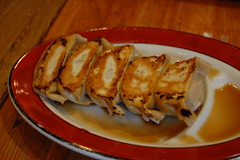
The gyōza were good, but nothing to write home about. I did find it interesting that the dipping sauce consisted solely of garlic, hot chile oil, and vinegar (rice, I think), with no hint of soy. In my extensive experience of gyōza (which I, having lived in Taiwan for more than a year, will always think of as jiaozi), soy is always sort of the foundation of the sauce, so this was new to me. Of course, on the bus home, it occurred to me that maybe you were supposed to add soy to this, as you have a soy sauce thing on your table already. I don’t know. It was fine, regardless, but as I say, nothing to write home about. You’ll note from the picture the standard Japanese way to serve them: you cook five or six pressed closely together in oil on a small nonstick fry pan, then add water about halfway up the sides and cover, and when the water boils off you pick them up, stuck together in a line, and serve them crispy-side up on an oval plate. I’ve never seen this in Taiwan, but everyone does it in Japan. I include here an example that wasn't from our lunch, but rather from "su-lin" photostream at Flickr, which is a pretty good representation of how they're usually presented at Japanese restaurants.
All told, Dragon Gate gets our thumbs up. It’s good Sichuan food, done well, at very reasonable prices. I’ll have to go for dinner some time and see whether the menu gets more extensive then, as is common, because I did think that the menu we saw was a bit short. In any case, if you like Sichuan food and are in Kyoto, they have four outlets, so try one.
Sunday, August 31, 2008
A Sichuan Lunch
Saturday, August 30, 2008
An Evil Experiment
Let’s talk about nattō (納豆), shall we?
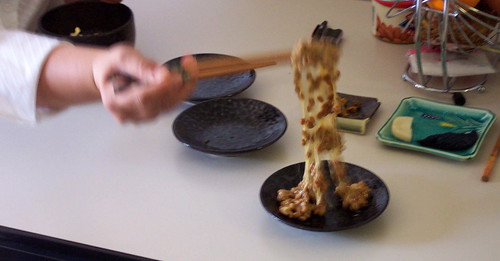
Nattō is fermented soybeans, which you stir up with rice, mustard, and sliced negi scallions, as well as sometimes other things like raw egg, bits of raw fish, and so on. I don’t mind fermented soybeans in a number of their forms, but this stuff is nasty and has a truly unpleasant texture, since when you stir it vigorously it develops slimy strings that resemble what comes out of your nose when you have a very bad cold.
Isn’t that delightful? Knew you would. If you are interested, search Flickr for "natto" and see what beautiful, horrible photos turn up (jasja dekker's photo is an especially lovely example).
The funny thing is, before I got here, I had an interesting experience with a Chinese-style hotpot dish I’d never had, in which the dipping sauce was made up of a whole bunch of weird things. Soy, sake (because we couldn’t find Shaoxing, the yellow rice wine), sesame oil, pungent shrimp paste, some kind of very spicy fish paste, and chunks of very-fermented tofu. You stir this up into a medium-thin paste and dunk your food in it. It was good, but I decided I didn’t really like the shrimp and fish things, so the next time around I did soy, sake, sesame oil, hot sesame oil, and the fermented tofu, and it was excellent. I ended up with jars of the makings, so I started putting this sauce together late at night as a snack. So my wife and I thought, “hey, if Chris likes this stuff, which is pretty pungent and basically nasty, he’ll probably like nattō.”
No such luck, it seems.
So… time for experiments. Maybe I just don’t like what the Japanese do with nattō, and think it could be done better some other way, right? Let’s try it: soy, sake, sesame oil, hot fermented bean paste (ladoubanjiang 辣豆瓣酱), and nattō, all whisked up together. We’ll try it with and without seafood pastes, for which in take two I’ll try karatarako (辛鱈子), which is semi-spicy salt-preserved pollock roe.
Here goes: my step by step in-process photos!
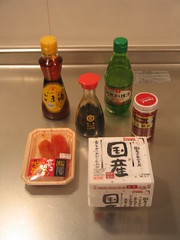
First, the fixin’s. Front and center, the nattō in its three-tiered supermarket package. Then, clockwise around, the karatarako, sesame oil, soy sauce, cooking sake (I’m not wasting good stuff on an experiment this dubious!), and doubanjiang.
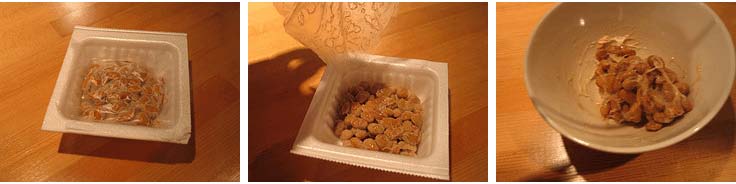
Now let’s take a good look at that yummy nattō! Open up the package and take a little stir….
And...
Okay now that our appetites are whetted, let me point out that nattō has a distinctive smell, not one that a whole lot of people outside Japan find attractive. Some say it smells a bit like blue cheese, and there’s a bit of truth in that, I suppose. Mostly I think it smells like itself, which I realize isn’t the most helpful thing to say. It’s pungent, a bit cheesy-musty, a little like overnight-soaked beans, and at the same time just a little bit nutty. If you can imagine that, I’ll bet you’ve had nattō already, because it’s not much of a description.
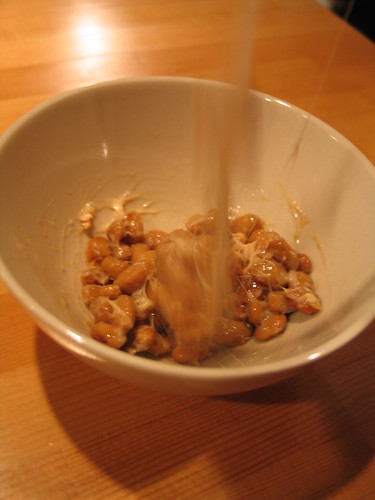
Now in this photo, I have added a medium dash of soy, a small dash of cooking sake, a splash of sesame oil, and about 1 Tb of doubanjiang, and then stirred vigorously. Looks unpleasant, doesn’t it? See those nice bubbles of gross sliminess, now special Chinese-style spicy gross sliminess?
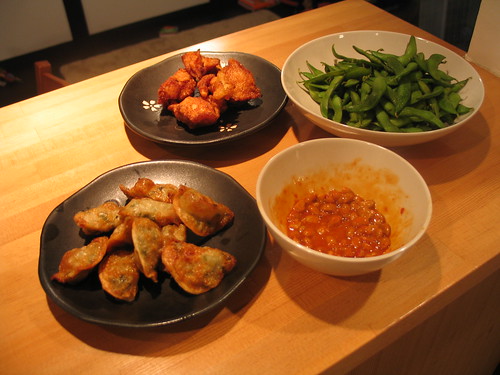
Here’s some bar food to eat with this delicious dish: deep-fried vegetable dumplings, kara age (fried chicken chunks), salty edamame beans boiled in the shell.
So what’s the verdict?
Actually, it’s not bad at all. It’s kind of pungent, and my wife insisted that before I go to bed I have to eat the last bit, because she doesn’t want the house to smell like nattō when she gets up in the morning. But suddenly it is transformed from slimy pungent stuff that has almost no good qualities to something that has a few unfortunate qualities (slime!) but is really quite decent. You wouldn’t want to eat a whole lot of it at once, I think, but a little bit is fine. The sticky slimy stuff turns into something almost resembling sauce, and it’s pretty good when you dunk the fried dumplings or chicken into it. The whole beans retain their firmness, and the sesame oil enormously complements the subtle nuttiness of the nattō.
So my conclusion? A couple things first….
For one thing, you have to take into consideration the fact that I used very low-end ingredients at every level, in the sense that whereas the soy is sort of mid-low grade, the nattō, sake, sesame oil, and doubanjiang are all rock-bottom basics. If I went with the best I could get, everything would be much improved, I am sure.
You also have to recognize that I have not yet tried the kara tarako (spicy Pollock roe) in the mix, and my current feeling is that there is something, some other pungent-rich flavor, that’s missing. My guess is that the roe will be perfect, although there are other things you could use (shrimp paste, uni, grilled eel liver, whatever), each of which would have its own powerful flavor to deepen and complicated the mixture. I will try this soon and keep you posted.
In the meantime, my conclusions?
Nattō isn’t half bad, and in fact can be quite decent in its way. The problem is that in my opinion, the Japanese don’t know what to do with it. They are under the impression that its worst qualities are its best, and they don’t understand that the pungent intensity of nattō requires other kinds of pungency to bring out its best qualities. As far as I’m concerned, nattō should be bar food: salty, pungent, spicy, and a bit rich, and served with cold beer. Eating it in the morning is bizarre.
I can see using mustard instead of doubanjiang, but I think the nutty fermented flavor of the latter helps develop the good side of the soybean flavor of the nattō. I like the sliced negi with the dish, and may try adding that when I also add the roe. I can see why you'd want to add the richness of egg, but I think it's slimy enough without raw egg, thanks very much, so I'll stick to sesame oil and perhaps the rich roe.
If you like nattō already, you are probably shocked by this conclusion. If you like nattō already, though, I can’t help you: it’s too late. If you don’t like it, you would possibly be pleasantly surprised by my concoction, and if you are ever under the gun to eat a big serving of the stuff I hope you will remember these principles. If you’ve never had it, I strongly recommend that you skip it.
Soba Out, French In
Today we went a little ways north and tried Honke Owariya (本家尾張屋), a soba restaurant that's been open since 1465.
I first learned about this place from
Sam, of course, suddenly decided that he wanted chicken instead of noodles, so he had an oyako donburi (親子丼), which is chicken and egg (oyako: mother and child) on rice. It was excellent. I must say that I do not usually like this dish all that much. It's fine, I guess, but I've never really understood why it's so popular. Owariya's version—hardly their specialty—made some of this clear to me. The chicken was juicy and tender, the egg just barely cooked and thus beautifully soft and moist, and the rice perfectly complemented the whole.
I
Sarah
All
Thanks, Kyoto Foodies!
Bocuse At Home
For dinner, I decided to make use of things on sale at my local grocery store: potatoes, cod roe, chicken bits of various kinds (as I think I've mentioned before, you can't readily get a whole chicken around here), tomatoes, local green peppers. I decided to make some recipes I found on Paul Bocuse's website. I figure if Bocuse likes it, it must be good.
First, classic Vichyssoise, the cold potato-leek soup invented at the New York Ritz a long time ago. I won't give recipes for this or anything, because they're posted for free. Here's the soup recipe. I used negi, the giant Japanese scallions, instead of leeks. They were mysteriously expensive today, so I didn't use as many as I should have, and so it came out more of a negi-potato soup. But it was certainly good. Needed more salt. That's one thing about cold soups: you have to salt them while they're hot or the salt won't dissolve easily, but salt loses its savor when it's cold so you have to oversalt. I didn't do enough.
Second, I did
Third,
Finally, I did a little cod roe persillade, for which I got the recipe from Jacques Pépin's website. I did not use fish liver, as it wasn't available without a search, whereas cod roe is pretty ordinary stuff around here. I think his recipe is intended for much larger roes than I was using, because it was just a little tougher than I'd have liked. But the flavor was excellent, and given that roes are constantly available and often very inexpensive this is certainly a dish I will experiment with. I think these little roes ought to have been poached in beurre monté rather than cooked brown on the outside first, and then you'd pour off most of the monté sauce before adding the garlic and parsley. I used a local citrus instead of lemon, but as the thing I used (sudachi, I think) is quite sour and good-tasting, it was a minor and positive adaptation.
Those with small children may be interested to know that Maia liked the roe, and that Sam pretended not to like it because (being 3) he was in one of those moods. Maia also liked the Vichyssoise, which Sam did not. Both of them liked the cheese—in fact, at one point we couldn't figure out why Maia was being such a pain, and it turned out she wanted to be fed more cheese.
All in all, I'm rather proud of myself doing all this in about 3 hours flat, much of which time I was doing other things as well. All the dishes were good, and in every case I can see pretty clearly how to improve the next time. Of course, it helps to be using recipes from two immensely respected world-class French chefs, but hey, I'll take the credit.
Wednesday, August 27, 2008
Review: Mos Burger
My basic opinion: it's rotten. Don't bother. Each burger is about $3 (¥320, give or take). The menu can be found at this website.
Now Sam wanted a hot dog, Sarah wanted a kinpira rice burger, and I decided to go for the Spicy Mos Cheeseburger. Here's what we got.
Certainly I think whoever is responsible for this hideousness known as Mos Burger deserves a good slapping, and should never again be allowed anywhere near the food industry.
Tuesday, August 26, 2008
After Some False Starts...
As it says in the description, I’m an academic, foodie, and passable home cook. I’m on sabbatical this year in Kyoto, along with my wife, who speaks Japanese (which I don't) and is teaching this year; my son Sam
(As you can see, Sam and Maia both like the local cuisine.)
Kyoto is often said to be the culinary heart of Japan, although these days Osaka has a pretty strong claim. The deal is, according to Kansai-area foodies, that Osaka is great for earthy, robust food, and Kyoto is more about subtlety and elegance. So this is where you get things like kaiseki, the rarefied cuisine of lots of little tiny dishes delicately prepared and subtly balanced to harmonize with the seasons and so on. I’ve never been a big fan of the whole simplicity thing, as you’ll discover, so this is a good opportunity for me to break some habits and learn something new.
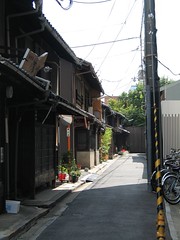
Now on the subject of false starts, the first thing was that our rented machia house (at the end of this street, on the left)
Then we heard about Muji (無印), or “no-name,” which we did. Things were a bit pricey, on the whole, but the quality seemed good and we found quite a lot of good stuff. The 100-yen shops had some really rock-bottom basics, too, but I still didn’t have a curve-sided pan or wok, for example, or a lot of other things. Finally we heard about Kawabata Nikku (川端ニック), which is up in the northeast, and that covered almost everything. So it took a week or so just to get some basics.
Turns out, incidentally, that restaurateurs don’t do what we did at all. In Tokyo, they go to Kappabashi, between Ueno and Asakusa, but there isn’t anything like that in Kyoto. But in Osaka, it seems, there is something called the Dōguya-suji Arcade (道具屋筋), right up from Den Den Town (where you get electronics of all kinds), and this is where you buy everything from plastic food displays to pots to whatever. Of course, if you want the best, you can buy in Kyoto from Aritsugu (有次), in Nishiki Market, but that’s all handmade craftsmanship and you can imagine what the prices are like. You’ll hear more about them when I get around to buying some of their beautiful (and expensive, but worth it) knives.
In passing, let me include the images I used for my header. Here you see some images of Nishiki Market, from the Flickr photostream “One Man’s Perspective,” and one of some Aritsugu knives, from the photostream “Ever Jean.”


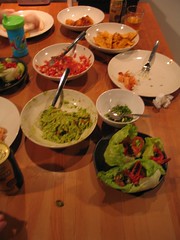
Well, anyway, now that I have equipment, I can make food. But my cookbooks are still in transit, so I have to do it all from memory and a few things I can find online. I did some basic Mexican
Rather than explain how to hack a fish to bits badly, I’ll end with a quick recipe for pumpkin soup. Next time, with any luck, I’ll manage to document something worth documenting, with photos along the way, and so on.
Pumpkin Soup
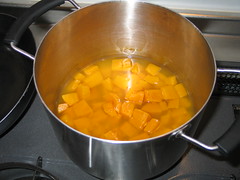
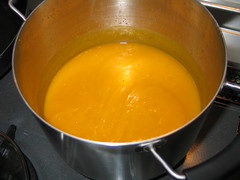
You need a couple of cups of skinned, seeded, coarsely chopped pumpkin, yellow squash, acorn squash, or whatever seems fresh. Add some mild stock to cover this; I used fish stock, which I made from the saury bones. Bring the mix to a rapid boil, cover, and simmer fast for 20-30 minutes or so, until the squash is falling to bits.
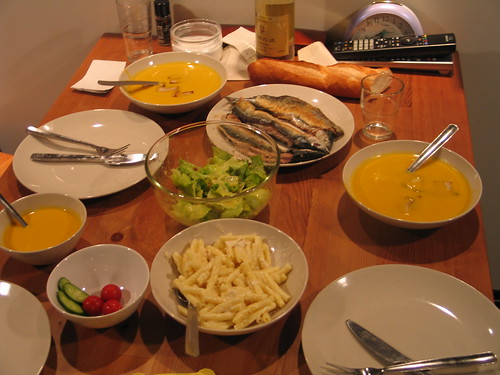
Here’s how dinner came out. The soup in the large bowls is garnished with a little seared sliced mushrooms. The mac and cheese is homemade, but cheese is not readily available in anything resembling quality, so I had to use something labeled "camembert" that tastes like American cheese --- Sam didn't mind. The wine is cheap Euro-plonk from Spain. As you see, I didn't bother with en colère this time (that's where you pull the tail of the fish through the mouth and saute that way), because I'm pretty sure the sanma'd have fallen to bits ; I just floured lightly and seared in a small amount of oil. Tasted good, if a bit bony here and there.
Next time, well, who knows? I'll try to do some restaurant reviews and photos, decent recipes and the like, documentation of my kids eating their way through Kyoto, and of course periodic rambling about Japanese food culture -- and homemaking culture, really, since that's what I'm doing. But I've got no clear plans, exactly. We'll see.
Subscribe to:
Comments (Atom)