Showing posts with label noodles. Show all posts

Thursday, April 16, 2009

Argh Argh Argh (An Especially Articulate Post)

Today I had a most aggravating foodie day. What made it so aggravating was that I’d planned in advance with some care.

First, I looked up when Passover ends, and read Wednesday. Which, of course, I took to mean sundown on Wednesday. So I made this whole plan to eat bread products and stuff on Thursday. Actually, though, it ends sundown Thursday. Not that I’m what anyone would call observant, since I eat shellfish and pork and mix milk with meat and all that. But it’s nice to make some effort once a year. Anyway, that’s one screw-up, which is my own. After that I take no blame.

Skimming one of my favorite Kyoto websites, Kyoto Foodie, I found a bunch of places in fair proximity to one another that are also easily accessible from Sam’s school. Since Sam only has half days at the moment — another annoying thing — I have to pick him up and take him for lunch. Now he adores udon noodles, as well as lots of things anyone would expect a little boy to like, such as ice cream, cake, fruit, and so on. It all clicked....

The Plan

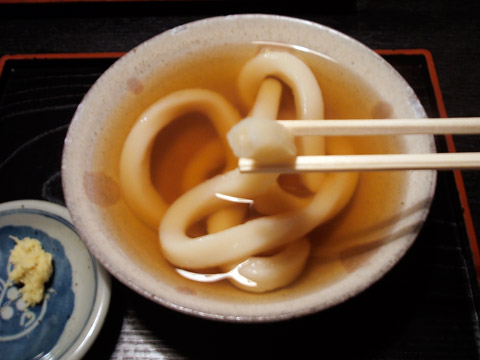
Pick up Sam at 11:40, and catch the #206 bus up to Senbon Imadegawa. Walk a couple of blocks west, and eat at Tawaraya, a famous udon place. Sam can have his usual order — plain (kake) udon noodles with kamaboko fish cake and no sliced scallions. I’ll have the specialty of the house, nihon udon, which is a bowl with just two gigantic (in all directions) noodles. Sounds like an interesting thing to try, and the Kyoto Foodie was fairly positive about it.

Next, walk a couple of blocks due east, ending just south of Senbon Imadegawa, and eat dessert at Chibeta. This is a super-fancy ice cream shop, and so far as my various contacts have learned, it’s about the only really good one, with their own homemade ice cream and sherbet in both classic flavors and their special inventions.

Next, walk a couple blocks more, basically northeast, ending at Le Petit Mec, which two completely unconnected foodie contacts assure me makes the best bread in Kyoto. Buy a fancy loaf to eat with dinner, and if Sam is interested he can have a sweet bread of some kind.

Go home, get him changed, and then play in the park until Mommy gets home.

That was the plan.

The Reality

Picked up Sam, found that he was wearing his exercise pants, but I carefully avoided asking him why: it means he wet his pants, and discussing that leads nowhere good in the short run. As we walked to the bus stop, I explained the plan, and he was amenable.

On the bus, he told me he didn’t want udon. He wanted hamburgers instead. Uh oh. We discussed it, and he decided udon would be okay after all. Whew! The plan was still clicking.

From Senbon Imadegawa, we walked to Tawaraya, which was just where the map indicated. There was something of a crush: apparently a school tour group was having lunch there. Fortunately, noodle places have quick turnover, and high school kids eat fast. We sat and waited, Sam was very good, and we got seated pretty soon. I ordered the specialty:


But this isn’t my photo. Why not?

Sorry, no nihon udon, says the guy. Eh? The specialty dish? It’s also not on the menu, which I find odd. My Japanese is too rudimentary to be sure whether they were sold out or have stopped making it, but in any event I wasn’t going to have it for lunch. Fine. I ordered cold udon with tempura for me, and for Sam the usual: plain hot udon in soup, with no scallion. No problem.

We wait. They serve the table next to us, which ordered after us. I sort of cock an eyebrow, and it becomes clear that our order has been missed. No biggie, these things happen, and fortunately Sam was behaving himself reasonably well. Our food finally arrives... and there’s scallions on Sam’s noodles. Argh! I’m not sending it back, no way. Instead, I pick every one off. Fortunately again, Sam just waits patiently, then eats without complaint.

Results: Frankly, I wasn’t very impressed. The udon place across the street from our house, where they know Sam and give him extra kamaboko (and would never, never give him scallion), is better, and definitely less crowded. When I paid the bill, I also found that Tawaraya is overpriced, albeit udon is never terribly expensive so it wasn’t a big deal. But ten-zaru udon (what I got) shouldn't cost $14, and $6 is steep for plain kake udon. I also noticed that the guy hadn’t written anything on the slip about no scallions on Sam’s noodles, which explains a lot. I still want to try the nihon udon some time, but I’m not nearly as sanguine about it now.

Okay, so now we hike to the ice cream shop. Doesn’t this stuff look delicious?


This isn’t my photo either, though. Because...

It’s closed.

You have to be kidding me. I could swear I looked it up and it isn’t supposed to be closed. There’s a workman’s ladder behind the main window. Maybe they’re closed for renovation or something? Anyway, no ice cream.

Sam was definitely annoyed about this. He mostly got over it when I made it clear that I was at least as annoyed as he was, but after all this walking and no ice cream, his fuse was clearly getting a bit short. I mean, he's not quite four yet, fair enough. So we went looking for other things, heading generally toward Le Petit Mec in hopes of salvaging things a bit — besides, they might have good cake or something.

No luck. The first coffee shop place we passed had a vast selection of coffee-flavored sweets and nothing else. The next was closed. Sam was getting tired of walking and walking, so we took the bus two stops, just past Le Petit Mec, with its beautiful bread...


Which was closed. You have GOT to be kidding me!

Fortunately we were still on the bus as we passed it, so we just didn’t get off until Horikawa, where there’s a fancy patisserie near the corner. We go in there, and Sam picks out a fruit thing that looks to me like he’s not going to like it. I ask him which I should have, and he picks a chocolate thing. I get both. But then it turns out that you can’t eat it there unless you get the cake-plus-drink set, which costs $6.50. Argh. I get ice coffee and milk, and we sit down.

Sam eats the fruit, but doesn’t like the custard, so he eats my chocolate thing. As it turns out, I don’t like the custard either, which tastes like it’s pure egg yolks and has a peculiar citrus flavor that I don’t think goes at all well with it. Heavy and sour, in short. I realize this is how they intend it to be, but I don’t like it. Ah well.

We head home, Sam dozes off on the bus and insists on being carried from the bus stop to the house, so my back starts hurting. Then he refuses to go the park and demands to watch Wall-E on TV instead. After this sequence of failures, I figure the park is probably in flames anyway, so what the heck, turn on the flick.

Aftermath

Then I check some websites.

Chibeta ice cream, closed Mondays. Why is it closed today? No idea.

Le Petit Mec bakery, closed... can that be right? It’s closed Monday through Thursday? How can they possibly run a business like that, weekends only? Weird.

Final tally: $33 for two servings of so-so udon and fancy but (to my taste) not great cake, getting and eating which took a total of about three hours.

Argh argh argh!
Stumble Upon Toolbar

Monday, December 15, 2008

Seven Lucky Gods

I got a chance to try another place for tantan men today. Unfortunately, it was very cold this morning, so I switched coats, and the result is that I didn’t have my camera. Argh. Oh well, the internet is a wonderful thing.

Today was Seven Lucky Gods (七福神), at the northeast corner of Horikawa-Oike. It’s a classic ramen joint: long counter, a couple of tables, open kitchen, and so on. Their specialties are a fish-broth ramen and their Ninth Street Scallion Tantan Men (kyujo-negi tantan men 九条ねぎ坦々麺).

Sam had miso ramen with roasted pork (chashu) and medium-boiled eggs, no negi. I ordered a batch of gyoza. And, of course, I had the tantan men.

The Rundown
All in all, a satisfying if rather strange approach to this dish. Here's a photo I found on-line (fortunately, all Japanese are apparently trained from the cradle to photograph their food and post it for public discussion):
The stock was strong and effective, with a definite pork flavor. The noodles were just about right in terms of richness, egg flavor, and bounce. And of course the 9th Street Scallions were good: that’s one of the kyo-yasai, the special Kyoto vegetables everyone’s on about these days.

But otherwise, the dish was very odd.

No ground pork topping: roasted pork instead. Minimal sesame flavor. A lot of togarashi (red chile), and very little rayu (spicy chile oil). No Sichuan peppercorn. And I’m pretty sure there was some sweet miso in there as well.

What's really peculiar is that the sign says that the kyujo-negi are certified to be really kyujo-negi by the Kyoto Agricultural Council, and that the rayu is special stuff from 山田油店, which appears to be in Saitama, north of Tokyo. But having made this production about it, there wasn't actually all that much negi and there sure as heck wasn't a lot of rayu.

By The Way
Sam adored his miso ramen. He’s no great judge, but certainly he was down on Ginza Shisen, as was I. I thought it was good miso ramen, but I admit I don’t have a whole lot of experience with that dish. This looks a good deal like what he ate -- again, an image I found on-line.

The bowlful Sam ate was a little different, in that it had no negi: Sam hates negi, and in fact all types of onions, in every form we have yet tried. And he has a surprising ability to detect them lurking behind other flavors, whatever they might look like.

The gyoza were classic Japanese gyoza: thin, under-flavored, thin-skinned. Not excellent, as they lacked the crunchy brownness of perfect gyoza. But well made, with none of the peculiar off cabbage flavors of Ginza Shisen. One thing I thought odd was the sauce with which they served these gyoza, which I couldn’t place at all (although eating tantanmen at the same time makes it a little difficult to identify subtle things without pretty strong cues).

I would bet that their fish ramen, and their more basic ramen offerings, would be good.

Assessment
In essence, this is tantanmen as another form of ramen, an approach I think is perfectly legitimate but which I’ve never seen taken to this extreme. The only way in which this bowl differed from any other miso ramen was in the replacement of sesame paste for some of the miso, and the admixture of some spicy stuff (togarashi and, according to the sign at least, rayu).

I would definitely recommend this to someone who’s a big fan of miso ramen and is looking for something a little different. As tantanmen per se, however, it’s very peculiar.

All of which makes it difficult to rate this entry.

As a dish, assessed on its own merits, I give it a 6/10: solid, tasty, well executed, but nothing spectacular.

As tantanmen, assessed with reference to that dish, I give it a 5/10: very tasty, but so outside the normal range that it gets some demerits.

I now think I should have rated Ginza Shisen lower, but them's the breaks.

Stumble Upon Toolbar

Wednesday, December 10, 2008

Tantan Men: Preliminary Tasting

My passing remark about how I intend to do a comparison tasting of a lot of different bowls of tantanmen in Kyoto has already prompted some slavering comments, so let’s get cracking.

Before the tasting begins, though, let’s consider what tantan men actually is.

Origins: Dan Dan Mian
Dandan mian
This is a Sichuan dish that is, at base, extremely simple. Take hot, fresh egg noodles. Toss with lots of chopped scallion, chili sauce (doubanjiang, for example), soy sauce, chili oil (la-yu), sesame paste, and usually some ground-up Sichuan peppercorns. Often some pickled vegetables are added. Carry it to work in a lunchbox, where the residual heat will bring out the flavors.

Made this way, the dish is a marvelous demonstration of the Sichuan penchant for simple, rustic, yet deep and complex dishes. Every major flavor is here: sweet (sesame paste), sour (in the sauce), salty (soy), bitter (raw scallion). In addition, you have two contested flavors: spicy (chilies) and fatty (sesame and oil). Depending on how the ingredients are prepared, there may also be more or less umami or savory, the famous “fifth flavor.”

And yet, there is nothing additional, no gilding, no tricks. The dish is at base as subtle as an axe. But made well, it’s a dish fit for a peasant or a king.

You will often see it said that there must be ground or minced pork in the dish, and while this is now usual, it is certainly a deviation from its peasant origins. After all, meat of any kind was long a rarity for Chinese peasants, and everything else about the dish bespeaks peasant simplicity. For the same reason, it is very unlikely that the dish would be served in soup, soup being again a delicacy requiring expensive ingredients, time, and cooking fuel.

Japanese Adaptation: Tan Tan Men
Tan Tan Men
I have seen it suggested that tantan men was invented by the “father of Sichuan cuisine” in Japan, Chen Kenichi, who later turned up as Iron Chef Chinese on the original Japanese Iron Chef show. In this account, Chen took a sort of vaguely gourmet version of dandanmian — with the pork, for instance — and made it into ramen-like soup noodles.

Whether this story is actually true or not, certainly the Japanese version is precisely thus. Instead of a sauce, there is a soup consisting of a pork broth (or sometimes chicken, or both) flavored with sesame paste, chili sauce, soy, and chili oil (rayu). Noodles are added, and then topped with minced pork, chopped scallions, sesame seeds, and some kind of vegetable — usually bok choy (chingensai), usually not pickled. In some cases, black sesame (paste and seeds) may be used in place of the usual white. More chili oil is commonly added as a pretty red garnish.

Now I like both the Sichuan version and the Japanese one, and a number of the many variations on the theme that I’ve tried. So, as noted in an earlier post, I have decided that it is my bounden duty to try a ridiculous number of different restaurants’ offerings of tantan men and tell you what I think of them, ultimately leading to a sort of guide.

To my mind, this makes more sense than a guide to ramen in Kyoto. I mean, ramen is all very well, but first of all, which style of ramen? And second, ramen is much too Japanese for me, and never nearly spicy or complicated enough. It’s fine, I guess, but my palate lies much closer to Sichuan and Hunan.

Before finally getting on to specific examples, let’s run through the four basics:

Stock — normally pork or pork-and-chicken. You should be able to tell.
Flavor Base — sesame, chili sauce, soy, and usually chili oil
Noodles — bouncy egg noodles, as in ramen
Topping — minced pork cooked with garlic, ginger, and Sichuan peppercorns until caramelized; green vegetable, pickled or otherwise, usually bok choy; chopped scallion; often sesame seeds; sometimes toasted whole dry chilies and/or toasted Sichuan peppercorns; often a drizzle of chili oil

Each of these basic four components should stand up for itself and be worth eating.

So without further ado....

Ginza Shisen (銀座四川)
Tan Tan Men
In the Porta underground shopping arcade, by Kyoto Station. Here is a Japanese website with links and some reviews and such, giving it an overall 5 out of 5: high marks indeed!

Just goes to show you what trust you can put in websites like that. All told, a pretty mediocre bowl, but so typical that I’ll use it as a first basic discussion.

Stock: Weak, thin, and lacking character. I’d guess it was pork stock, but it tasted mostly of salt. No depth of flavor to stand up to the other ingredients.

Flavor Base: Somebody tell these guys about chili sauce (doubanjiang), because apparently they forgot it. Thus the flavoring was sweet and rich, and rather salty, but lacked both the fire and the complex sourness of chili sauce. As a result it seemed, again, thin and lacking character.

Noodles: Respectable ramen noodles, but a little too eggy for my taste. This would have been perfect for the dish, actually, if the other things had stood up to it — if your noodles are too light they ought to be overpowered.

Toppings: Minced pork appeared to be simply stir-fried without any significant flavoring, and certainly wasn’t caramelized; bok choy was respectable; minimal scallion; no sesame seeds; and finally a couple drops of chili oil off to the side as a sort of ironic comment on the lack of flavor here. No hint of Sichuan peppercorns anywhere.

The thing is, I’d currently give this about a 4 out of 10. From what I’ve said, it sounds like I’d give it a right panning, but in fact, it was well within the average range of tantan men as I’ve had it in Kyoto. Weak, thin, low on flavor, poorly balanced, and basically lacking depth or force... but that’s the way most Japanese seem to like it. Sichuan peppercorns are rare indeed, which means that the dish usually lacks the numbing-spicy special flavor that is distinctive to Sichuan.

Which, in fact, is precisely why I’m doing this little quest. I want to find tantan men made the way I think it should be, not the way they do. I mean, of all people to get Sichuan food wrong, I’d put the Japanese and the English at the top of the list: they don’t like hot spices, garlic, or robust and even brutal flavors. (Let’s not talk about what they call “curry,” okay? The really spicy-hot curries are worse, actually, because they’re just hot with no depth.)

To conclude, I noticed on the way out that more or less next to Ginza Shisen is another place that serves tantanmen, so pretty soon it’s back to Porta for another bowl.

As time goes by (sing with me!), I will post more reviews, and I will also progressively refine my own secret recipe. Ultimately I hope to develop a recipe that is as good as any in Kyoto. And if I can’t, I hope it’s because I’ve found some truly killer tantanmen.

Stumble Upon Toolbar

Friday, December 5, 2008

Lovely Chinese Lunch

I’m starting to work on an entry about Tan Tan Men (淡々面), the Japanese version of the classic Sichuan dish Dan Dan Mian. It’s a spicy bowl of noodles I love in both forms, and just about every semi-Chinese place has them at lunchtime. So I’m going around cataloguing, trying bowl after bowl of noodles, taking pictures, and so on.

But I just had to share this place.
Tan Tan Men 01
I had some trouble finding these characters, partly because they’re so stylized in the sign, but I think this place is called Sen Gō Kan (膳豪漢). A local on-line restaurant place gives the characters as 膳處漢, but I think they're misreading the middle character -- at any rate, that's not what this sign says. Admittedly, I also think I've got the middle character wrong, but it appears to be extremely obscure and I don't have really good dictionaries to hand. On the other hand, Google maps and such do give the other version. I don't care, the noren has different characters, so there. Anyway, it’s on Nishikikōji-dōri, between Muromachi-dōri and Shinmachi-dōri.

The first time we went there, I had black sesame Tan Tan Men, and my wife had the dim sum set lunch. Both were wonderful. But just when my wife was feeling pretty full, they came in and gave her one more thing: a bowl of shark’s fin noodle soup. This seemed like overkill, but it looked great, and she had a little, and I tasted it... And then the waiter comes zipping back in all apologetic: this wasn’t supposed to come with the set lunch, but was ordered by another table. My wife is equally apologetic: it’s fine if they take it, but they ought to know we’ve tasted it already. The waiter looks pretty worried, and goes off. He comes back with the manager, who says, “no, don’t worry, just eat it. No problem.” So we had a gourmet extra!

Now since then, I’ve gone back by myself several times. I always think maybe I’ll try something else, but then I can’t resist the black sesame noodles, which look like this:
Tan Tan Men 01
This time, I also ordered gyoza. I happened to notice that they come in two plate sizes: 3 dumplings or 6. This is odd, because usually they come about 5 or so to an order, and the price isn’t spectacularly low. So I figure, what the hey? And when they arrive, I see why:
Tan Tan Men 01
These things are huge! Unfortunately, they do have that thin skin the Japanese like, where I like them a little more robust, but at least these ones weren’t the ultra-thin paper-skinned ones that I think are silly.

Anyway, I just had to show you my lunch.

Stumble Upon Toolbar