Showing posts with label Chinese. Show all posts

Monday, December 15, 2008

Seven Lucky Gods

I got a chance to try another place for tantan men today. Unfortunately, it was very cold this morning, so I switched coats, and the result is that I didn’t have my camera. Argh. Oh well, the internet is a wonderful thing.

Today was Seven Lucky Gods (七福神), at the northeast corner of Horikawa-Oike. It’s a classic ramen joint: long counter, a couple of tables, open kitchen, and so on. Their specialties are a fish-broth ramen and their Ninth Street Scallion Tantan Men (kyujo-negi tantan men 九条ねぎ坦々麺).

Sam had miso ramen with roasted pork (chashu) and medium-boiled eggs, no negi. I ordered a batch of gyoza. And, of course, I had the tantan men.

The Rundown
All in all, a satisfying if rather strange approach to this dish. Here's a photo I found on-line (fortunately, all Japanese are apparently trained from the cradle to photograph their food and post it for public discussion):
The stock was strong and effective, with a definite pork flavor. The noodles were just about right in terms of richness, egg flavor, and bounce. And of course the 9th Street Scallions were good: that’s one of the kyo-yasai, the special Kyoto vegetables everyone’s on about these days.

But otherwise, the dish was very odd.

No ground pork topping: roasted pork instead. Minimal sesame flavor. A lot of togarashi (red chile), and very little rayu (spicy chile oil). No Sichuan peppercorn. And I’m pretty sure there was some sweet miso in there as well.

What's really peculiar is that the sign says that the kyujo-negi are certified to be really kyujo-negi by the Kyoto Agricultural Council, and that the rayu is special stuff from 山田油店, which appears to be in Saitama, north of Tokyo. But having made this production about it, there wasn't actually all that much negi and there sure as heck wasn't a lot of rayu.

By The Way
Sam adored his miso ramen. He’s no great judge, but certainly he was down on Ginza Shisen, as was I. I thought it was good miso ramen, but I admit I don’t have a whole lot of experience with that dish. This looks a good deal like what he ate -- again, an image I found on-line.

The bowlful Sam ate was a little different, in that it had no negi: Sam hates negi, and in fact all types of onions, in every form we have yet tried. And he has a surprising ability to detect them lurking behind other flavors, whatever they might look like.

The gyoza were classic Japanese gyoza: thin, under-flavored, thin-skinned. Not excellent, as they lacked the crunchy brownness of perfect gyoza. But well made, with none of the peculiar off cabbage flavors of Ginza Shisen. One thing I thought odd was the sauce with which they served these gyoza, which I couldn’t place at all (although eating tantanmen at the same time makes it a little difficult to identify subtle things without pretty strong cues).

I would bet that their fish ramen, and their more basic ramen offerings, would be good.

Assessment
In essence, this is tantanmen as another form of ramen, an approach I think is perfectly legitimate but which I’ve never seen taken to this extreme. The only way in which this bowl differed from any other miso ramen was in the replacement of sesame paste for some of the miso, and the admixture of some spicy stuff (togarashi and, according to the sign at least, rayu).

I would definitely recommend this to someone who’s a big fan of miso ramen and is looking for something a little different. As tantanmen per se, however, it’s very peculiar.

All of which makes it difficult to rate this entry.

As a dish, assessed on its own merits, I give it a 6/10: solid, tasty, well executed, but nothing spectacular.

As tantanmen, assessed with reference to that dish, I give it a 5/10: very tasty, but so outside the normal range that it gets some demerits.

I now think I should have rated Ginza Shisen lower, but them's the breaks.

Stumble Upon Toolbar

Wednesday, December 10, 2008

Tantan Men: Preliminary Tasting

My passing remark about how I intend to do a comparison tasting of a lot of different bowls of tantanmen in Kyoto has already prompted some slavering comments, so let’s get cracking.

Before the tasting begins, though, let’s consider what tantan men actually is.

Origins: Dan Dan Mian
Dandan mian
This is a Sichuan dish that is, at base, extremely simple. Take hot, fresh egg noodles. Toss with lots of chopped scallion, chili sauce (doubanjiang, for example), soy sauce, chili oil (la-yu), sesame paste, and usually some ground-up Sichuan peppercorns. Often some pickled vegetables are added. Carry it to work in a lunchbox, where the residual heat will bring out the flavors.

Made this way, the dish is a marvelous demonstration of the Sichuan penchant for simple, rustic, yet deep and complex dishes. Every major flavor is here: sweet (sesame paste), sour (in the sauce), salty (soy), bitter (raw scallion). In addition, you have two contested flavors: spicy (chilies) and fatty (sesame and oil). Depending on how the ingredients are prepared, there may also be more or less umami or savory, the famous “fifth flavor.”

And yet, there is nothing additional, no gilding, no tricks. The dish is at base as subtle as an axe. But made well, it’s a dish fit for a peasant or a king.

You will often see it said that there must be ground or minced pork in the dish, and while this is now usual, it is certainly a deviation from its peasant origins. After all, meat of any kind was long a rarity for Chinese peasants, and everything else about the dish bespeaks peasant simplicity. For the same reason, it is very unlikely that the dish would be served in soup, soup being again a delicacy requiring expensive ingredients, time, and cooking fuel.

Japanese Adaptation: Tan Tan Men
Tan Tan Men
I have seen it suggested that tantan men was invented by the “father of Sichuan cuisine” in Japan, Chen Kenichi, who later turned up as Iron Chef Chinese on the original Japanese Iron Chef show. In this account, Chen took a sort of vaguely gourmet version of dandanmian — with the pork, for instance — and made it into ramen-like soup noodles.

Whether this story is actually true or not, certainly the Japanese version is precisely thus. Instead of a sauce, there is a soup consisting of a pork broth (or sometimes chicken, or both) flavored with sesame paste, chili sauce, soy, and chili oil (rayu). Noodles are added, and then topped with minced pork, chopped scallions, sesame seeds, and some kind of vegetable — usually bok choy (chingensai), usually not pickled. In some cases, black sesame (paste and seeds) may be used in place of the usual white. More chili oil is commonly added as a pretty red garnish.

Now I like both the Sichuan version and the Japanese one, and a number of the many variations on the theme that I’ve tried. So, as noted in an earlier post, I have decided that it is my bounden duty to try a ridiculous number of different restaurants’ offerings of tantan men and tell you what I think of them, ultimately leading to a sort of guide.

To my mind, this makes more sense than a guide to ramen in Kyoto. I mean, ramen is all very well, but first of all, which style of ramen? And second, ramen is much too Japanese for me, and never nearly spicy or complicated enough. It’s fine, I guess, but my palate lies much closer to Sichuan and Hunan.

Before finally getting on to specific examples, let’s run through the four basics:

Stock — normally pork or pork-and-chicken. You should be able to tell.
Flavor Base — sesame, chili sauce, soy, and usually chili oil
Noodles — bouncy egg noodles, as in ramen
Topping — minced pork cooked with garlic, ginger, and Sichuan peppercorns until caramelized; green vegetable, pickled or otherwise, usually bok choy; chopped scallion; often sesame seeds; sometimes toasted whole dry chilies and/or toasted Sichuan peppercorns; often a drizzle of chili oil

Each of these basic four components should stand up for itself and be worth eating.

So without further ado....

Ginza Shisen (銀座四川)
Tan Tan Men
In the Porta underground shopping arcade, by Kyoto Station. Here is a Japanese website with links and some reviews and such, giving it an overall 5 out of 5: high marks indeed!

Just goes to show you what trust you can put in websites like that. All told, a pretty mediocre bowl, but so typical that I’ll use it as a first basic discussion.

Stock: Weak, thin, and lacking character. I’d guess it was pork stock, but it tasted mostly of salt. No depth of flavor to stand up to the other ingredients.

Flavor Base: Somebody tell these guys about chili sauce (doubanjiang), because apparently they forgot it. Thus the flavoring was sweet and rich, and rather salty, but lacked both the fire and the complex sourness of chili sauce. As a result it seemed, again, thin and lacking character.

Noodles: Respectable ramen noodles, but a little too eggy for my taste. This would have been perfect for the dish, actually, if the other things had stood up to it — if your noodles are too light they ought to be overpowered.

Toppings: Minced pork appeared to be simply stir-fried without any significant flavoring, and certainly wasn’t caramelized; bok choy was respectable; minimal scallion; no sesame seeds; and finally a couple drops of chili oil off to the side as a sort of ironic comment on the lack of flavor here. No hint of Sichuan peppercorns anywhere.

The thing is, I’d currently give this about a 4 out of 10. From what I’ve said, it sounds like I’d give it a right panning, but in fact, it was well within the average range of tantan men as I’ve had it in Kyoto. Weak, thin, low on flavor, poorly balanced, and basically lacking depth or force... but that’s the way most Japanese seem to like it. Sichuan peppercorns are rare indeed, which means that the dish usually lacks the numbing-spicy special flavor that is distinctive to Sichuan.

Which, in fact, is precisely why I’m doing this little quest. I want to find tantan men made the way I think it should be, not the way they do. I mean, of all people to get Sichuan food wrong, I’d put the Japanese and the English at the top of the list: they don’t like hot spices, garlic, or robust and even brutal flavors. (Let’s not talk about what they call “curry,” okay? The really spicy-hot curries are worse, actually, because they’re just hot with no depth.)

To conclude, I noticed on the way out that more or less next to Ginza Shisen is another place that serves tantanmen, so pretty soon it’s back to Porta for another bowl.

As time goes by (sing with me!), I will post more reviews, and I will also progressively refine my own secret recipe. Ultimately I hope to develop a recipe that is as good as any in Kyoto. And if I can’t, I hope it’s because I’ve found some truly killer tantanmen.

Stumble Upon Toolbar

Friday, December 5, 2008

Lovely Chinese Lunch

I’m starting to work on an entry about Tan Tan Men (淡々面), the Japanese version of the classic Sichuan dish Dan Dan Mian. It’s a spicy bowl of noodles I love in both forms, and just about every semi-Chinese place has them at lunchtime. So I’m going around cataloguing, trying bowl after bowl of noodles, taking pictures, and so on.

But I just had to share this place.
Tan Tan Men 01
I had some trouble finding these characters, partly because they’re so stylized in the sign, but I think this place is called Sen Gō Kan (膳豪漢). A local on-line restaurant place gives the characters as 膳處漢, but I think they're misreading the middle character -- at any rate, that's not what this sign says. Admittedly, I also think I've got the middle character wrong, but it appears to be extremely obscure and I don't have really good dictionaries to hand. On the other hand, Google maps and such do give the other version. I don't care, the noren has different characters, so there. Anyway, it’s on Nishikikōji-dōri, between Muromachi-dōri and Shinmachi-dōri.

The first time we went there, I had black sesame Tan Tan Men, and my wife had the dim sum set lunch. Both were wonderful. But just when my wife was feeling pretty full, they came in and gave her one more thing: a bowl of shark’s fin noodle soup. This seemed like overkill, but it looked great, and she had a little, and I tasted it... And then the waiter comes zipping back in all apologetic: this wasn’t supposed to come with the set lunch, but was ordered by another table. My wife is equally apologetic: it’s fine if they take it, but they ought to know we’ve tasted it already. The waiter looks pretty worried, and goes off. He comes back with the manager, who says, “no, don’t worry, just eat it. No problem.” So we had a gourmet extra!

Now since then, I’ve gone back by myself several times. I always think maybe I’ll try something else, but then I can’t resist the black sesame noodles, which look like this:
Tan Tan Men 01
This time, I also ordered gyoza. I happened to notice that they come in two plate sizes: 3 dumplings or 6. This is odd, because usually they come about 5 or so to an order, and the price isn’t spectacularly low. So I figure, what the hey? And when they arrive, I see why:
Tan Tan Men 01
These things are huge! Unfortunately, they do have that thin skin the Japanese like, where I like them a little more robust, but at least these ones weren’t the ultra-thin paper-skinned ones that I think are silly.

Anyway, I just had to show you my lunch.

Stumble Upon Toolbar

Sunday, September 14, 2008

Chinese Weirdness

I was getting rather tired of Japanese/French semi-fusion food, which I have been doing for the last few days. I think I first realized I was getting tired of it when I plated a sanma (Pacific saury, very similar to a small mackerel or a large sardine) tartare in a perfect cylinder topped with an even layer of salmon roe, garnished with a vinaigrette sauce adorned with capers and chopped hard-boiled eggs, and thought I should probably photograph this for the blog---and then thought, "ah, what the hell, too much trouble." This despite the fact that I got this recipe from Le Bernardin's cookbook (the 4-star fish restaurant in New York), made some fairly clever substitutions based on availability in Japan at this season, and all in all made something that was perfect for blogging. Turns out, I was getting tired of this. Why?

All that protein, I guess. I mean, you've got fish, and more fish, and eggs, and then vinegared stuff to brighten the flavors... but where are the veggies? Turns out, the Japanese are on the whole kind of bad about this. They do eat some vegetable superfoods, like fresh soybeans (edamame) and various seaweeds, but they're really not great about fresh vegetables in general. They'd rather pickle them, which is fine but gets us right back to the vinegar and salt thing.

Well, since I now have a passable sense of what I can get in the local market, produce-wise, I went to my cookbook collection (which has now arrived, thank goodness). I was sort of idly turning pages, flipping through different books, but nothing seemed very appealing. And then... my eye happened on Barbara Tropp's wonderful Modern Art of Chinese Cooking. Oh yes---Chinese stir-fry! Bright flavors, handled quickly and intensely. And I should be able to get everything very easily, this being East Asia, after all, where the influence of China has been almost overwhelming for a very, very long time.

So I went on a shopping expedition and found...

Huh?

Wait just a second. I'm in Japan, right? I'm in what is probably the culinary center of Japan, where every other shopfront is a restaurant and people are absolutely stark, staring bonkers about food. I'm in a place where people will pay as much at a good Chinese restaurant as they'd pay at a good French restaurant.

But I can't get cilantro. I can't get black soybeans. I can't get Chinese-style roasted sesame paste. I can't get Chinese wine. I can't get hoisin sauce. I can't get Sichuan peppercorns. What the hey?

A Little Rant
If you don't know much about Chinese cooking, or about Japanese history, you may not see why I think this is quite as bizarre as I do.

The first point is that almost everything in Japanese aesthetic history really starts with China. You constantly see all sorts of stuff about how distinctively Japanese is that stuff about empty space, simple wooden architecture, paper shoji screens and tatami mats, and so on. But all of that is very closely patterned on certain dominant aesthetic trends in China in the Tang dynasty, when the Japanese first had really extensive and intricate intellectual exchanges with China. In theory, this is when Buddhism came over to Japan; almost certainly it arrived earlier from Korea, but from the Japanese perspective it's all China. The same thing goes for the writing system: the Japanese writing system is adapted from the Chinese, using the same characters (kanji) plus a series of wildly simplified characters that serve as a syllabary (the kana).

The second point is that many of these ingredients are not only common in Chinese cuisine, but elsewhere. Cilantro is native from southwestern Asia to north Africa, but it has been spread around the globe. Wikipedia notes, correctly, that cilantro or "coriander is commonly used in Middle Eastern, Mediterranean, Indian, South Asian, Latin American, Chinese, African and Southeast Asian cuisine." Note the odd man out: Japan. Yet beyond so-called traditional Japanese food, some of the most popular kinds of restaurants in Japan are Chinese, Mediterranean, Indian, and Southeast Asian. What's more, there is the longstanding connection between Japan and Brazil, where once again cilantro is very popular (it is essential as a final garnish on feijoado, the national dish).

Beyond cilantro, let me note that Sichuan peppercorn is actually the same plant, so far as I can tell, as what the Japanese call sansho, the only difference being that the Japanese generally use the green leaves while in Sichuan you use the dried berries in their husks. If you're cultivating the plant, why isn't it available?

A really irritating example here is fermented black soybeans. The Japanese love fermented soybeans--see my experimental discussion of nattō. The Chinese black beans are prepared a bit differently, but I cannot imagine that many Japanese would not like the taste. In fact, I know for certain that seafood steamed or stir-fried in black bean sauce is extremely popular in Chinese restaurants here. So why can't I get the stuff?

I could see it if I were talking about ingredients that don't keep well or something, and perhaps that is part of the problem with the cilantro, though I rather doubt it. But everything else I'm talking about keeps for years. Literally: you can buy a vacuum-sealed package of black beans and not open them for a couple of years, and they'll be just fine.

Now I'm sure I could get Chinese wine (Shaoxing wine, for example) if I wanted it, if I just scoured the local liquor stores. But this is easy to substitute: if you're not using very much, sake will be perfectly acceptable. But the other things are not something you can work around: you cannot make something steamed in black bean sauce without black beans.

I decided to say what the hell and make what I could, with some appropriate substitutions insofar as I could get away with it, and the results were pretty good. But I remain mystified.

If any reader can tell me what's going on here, why I cannot find the most basic Chinese ingredients after searching several fairly large grocery stores, I will be very grateful!

Chinese Dinner At Home
For some reason I haven't been in the Chinese-cooking mode for a while now, and I'd forgotten how much fun it is. You can do almost everything difficult well in advance, and you plan around what burners and stuff you have. At more or less the last minute you whip it together, with lots of panache and clanging and general fun--if you're stir-frying in a wok over very high heat, you can also get some nice flare-ups which are exciting to watch--and you can quickly dish up a whole bunch of different things. What's more, almost everything keeps, and can be eaten cold, or reheated, or whatever; if there's something that doesn't reheat (like clams or something, for example), you just tell your family they have to finish that one off.

My only disappointment with cooking Chinese now is that Sam won't eat things that are spicy, which puts a damper on my enthusiasm for Sichuan and Hunan cuisines--an enthusiasm shared by Tropp, which is another reason I adore her cookbook. (Tropp died tragically young in 2001, and so far as I know only completed two cookbooks: The Modern Art of Chinese Cooking and then the China Moon Cookbook. If you don't have the first one, get it!)

Still, I managed a few dishes, despite all: Don-Don Noodles, Ma-La Chicken, Wine-Explosion Vegetable Soup, and fry-steamed Jiaozi dumplings (for the latter, I used frozen premade, I'm afraid, and they turned out to be not great).

Don-Don Noodles
I love this kind of flavor: bracing, intense, and complicated, with a heady waft of spice. It's typically Sichuan, I think, and couldn't be easier to make. In fact, I made the entire shebang in advance, then nuked it, because I didn't have an extra burner to use.

There are two components: noodles with carrot shreds and peanut sauce.

I used udon noodles, which are good and plentiful here (and I had a zillion packets of really good ones in the freezer), but at home I'd go with the Chinese preference for fresh egg noodles. Whatever you use, you need it to be firm, bouncy, and preferably a little assertive, but don't worry if they turn out a bit wimpy: no self-respecting noodle is going to stand up to a sauce like this. I boiled the noodles until a bit underdone, then drained and rinsed in cold running water until quite cool, then drained again. Then I added 2 Tb toasted sesame oil (you need the Chinese or Japanese stuff, which is brown, not the "cold-pressed" or middle-Eastern stuff that is more or less clear) and tossed until all the noodles were coated. I took two medium-fat carrots, peeled them, split them down the middle, put them cut-side down on a board, and then used a vegetable peeler flat to the board to shave them into thin slices. These slices I stacked and set up more or less parallel, and with a knife cut them into fine julienne. I tossed the carrots with the noodles, covered with plastic, and refrigerated. You can leave them like this for 24 hours or more without any problems at all. To reheat, I just nuked them on medium-high power until they were warm-to-hot throughout.

To make the sauce, put 10-12 fat cloves of garlic (peeled) into the food processor and whiz, scraping down a couple of times, until semi-fine. Add about a bunch of mitsuba and some shiso leaves, all chopped up coarsely; in a sane world, just add a medium bunch of cilantro, coarsely chopped. Whiz on pulse again, scraping down often, until the whole thing is pretty fine. Now add half a cup of peanut butter (the organic kind that separates is infinitely superior) and whiz briefly to combine. Add half a cup of good soy sauce, a few Tb sugar, a small dash of sake (you should use Shaoxing wine, or maybe good dry sherry, but again...), and a couple Tb hot chili oil (try to get the kind that has scary red goo on the bottom of the jar, which I find tastes and mysteriously keeps better). Whiz, scrape, whiz, scrape, and continue until it's all pretty smooth, which doesn't take long. Taste: if it's intense but not exciting, add another Tb sugar and whiz again. Don't overdo the chili oil, as it will get hotter as it sits. Scrape the mix into a small bowl, cover with plastic, and let sit on the counter for a couple of hours. Refrigerated in a sealed tupperware, it'll keep for a very long time, but be sure to let it come to room temperature before serving.

To serve the dish, just plop the noodles down on a plate and top with the sauce, or have your guests add as much as they like. To eat, you sort of toss up the noodles and sauce (and carrots, obviously) with your chopsticks until it's all more or less combined, and then eat. If all has gone well, it will seem very mild-mannered for a bite or two, and then creep up and belt you one between the eyes.

My version was just fine, but lacked that high fragrance of the cilantro. I also thought the chili oil was wimpy.

Ma-La Chicken Cold chicken salad garnished with special hot-spicy-numbing oil. Came out a treat, I thought, and again, couldn't be easier. The only pain is the plating, and you don't have to go in for the silliness I did -- I just felt like it, okay?

There are four components: cold raw veg (usually cucumbers), cold blanched veg (asparagus, green beans, longbeans, whatever -- usually green, though), cold moist-poached chicken (breasts are better for this, but it really doesn't matter much), and the special oil. Then you have some dressings, for which my favorite is a sesame-paste one or the coriander dressing I used in the noodles (make extra and these two dishes are easy -- but a little repetitive).

The cold raw veg is... cold and raw. That was hard. Just slice and arrange.

The blanched veg: I used asparagus, as I say. Cut the pieces about 1-2" long, preferably at an angle, rolling a quarter-roll around between cuts so the ends are not parallel. Blanch asparagus about 1 minute in very fast-boiling water, beans maybe 90 seconds, and so on, just until barely cooked but very crunchy. Immediately shock in ice water, then drain and chill until serving time. To serve, put in a wide mound in the center.

The sesame paste sauce is a breeze with an immersion blender. Put a few Tb Chinese sesame paste (which is brown) in a small bowl. Add a Tb or so sesame oil, soy sauce, tamari (only the best brands -- check, because many are not tamari at all but rather colored pseudo-soy), sugar, and hoisin sauce, and a generous dash of hot chili oil. I replaced the sugar and hoisin sauce with a couple Tb tonkatsu sauce, which is sort of a mediocre variety of sweet hoisin -- this is kind of like replacing canned tomato sauce with ketchup, but it works. Whiz the whole works until smooth, add a tiny dash warm water and whiz again, and then taste. It should be thick but pourable. Let develop, covered, on the counter for a few hours. Keeps more or less forever in the fridge, but again, bring back to room temperature before using.

The chicken is a special Chinese trick. Get one chicken breast, on the bone, with skin. Take some slices of ginger, preferably spanking them firmly with a cleaver-side or tenderizer to open the pores, and put them in a little pot. Add some scallion chunks, spanked. Add some Sichuan peppercorn if you can get it, which I can't, as you know. Garlic doesn't work here, I'm afraid. Fill the pot up about 1" from the rim, cover, and bring to a rapid boil. Meanwhile, go over your chicken breast and remove any bloody bits or other nastiness. When the water is boiling fast, turn off the heat and immediately slide the chicken into the water. Poke it under with a fork or chopstick or something and cover the pot. Leave for at least 2 hours. When you're ready to serve, pull out the breast, peel off the skin, and peel the meat in one piece off the bone (it will come pretty easily). Put it flat on the board and slice at a steep angle against the grain into thin slices. The meat will be just cooked through and extremely moist. Mound it prettily on the asparagus or whatever.

Before you actually start slicing anything, though, put a few Tb each plain cooking oil and roasted sesame oil in a very small pan. In a small prep bowl, put a few coins of fresh ginger, a tablespoon or so of scallion rings, a dash of Sichuan peppercorns (I used powdered sansho), and some dried chili flakes or a couple of whole dried chilies. Swirl the oils to mix, add one ring of scallion to the oils, and place over medium heat. When the scallion starts to sizzle pretty well, remove the pan from heat and add the contents of the prep bowl. Shake-swirl to mix it up, and then put the bowl off heat somewhere to develop flavor. When the salad is all plated up, the oil should still be warm but not broiling hot. Remove the ginger coins with chopsticks, add a small dash of soy sauce and swirl to mix, and then immediately pour the whole mixture gently over the top of the chicken, making sure most of the various chunky things in the oil remain on the chicken.

My version was pretty decent, but the chili flavor didn't develop well. I think I didn't really heat the oil enough, for one thing, and next time I'll also break open those whole chilies and shake out the seeds, to see if that works. The special Sichuan peppercorn flavor wasn't there, but that's the fault of Japan. The sesame sauce was pretty decent, I thought, but there wasn't enough of it. I didn't like the mustard sauce I made, so I won't give a recipe.

Soup
Was soup. Good soup, but soup. Basically what you do is you prep all your vegetables, and divide them into those requiring more cooking and those requiring less. You have good chicken stock on hand, and you whisk up 4 Tb cornstarch in 6 Tb cold stock or water for every 6 cups of stock in the soup; that is, for each cup soup stock, mix 1 Tb stock and 2 tsp cornstarch. Leave the spoon in the mix, as it will quickly settle out again. Whisk an egg white, whole egg, or two egg whites (up to you: it depends how much egg thread you like) in a small bowl, just until more or less smooth, not frothy.

Heat a big pot quite hot over medium-high heat. Add 1 Tb or so oil and swirl to glaze. Add a few Tb rice wine (I had to use sake, which is much too mild for this, but what the hey), which will immediately flash into a boil. Instantly add all the plain stock: I used about 6 cups. When it boils, add the veg for long cooking, bring back to a boil, lower heat, and simmer a minute or two, stirring occasionally. Add the veg for shorter cooking, stir, and cook a few minutes more. Turn the heat very low. Taste for seasoning, and add salt as needed. Add sugar too: if the flavor seems flat, add sugar to brighten mediocre vegetables. Whisk up the cornstarch mix again and add it, then stir constantly and gently for a couple of minutes until the soup turns glossy and just a bit thick -- it won't really clarify, but you'll notice its texture changing dramatically. Now pour in half the egg in a gentle circle, wait a second, stir gently, then pour in the rest the same way, wait a second more, and stir again gently. You should now have floating threads of barely-cooked egg. Serve the soup immediately, garnished maybe with a little finely-cubed ham.

Personally, I think this soup was a little blah -- the blurry photo does it justice, I guess. Maybe I didn't add enough sugar, but I think it just wasn't cool enough to hold its own against the noodles and chicken. I think it maybe needed something with a little brightness, or maybe just a dash of soy, or... maybe decent Chinese rice wine instead of Japanese sake? Could be: the sake just seemed insipid and bland, whereas nobody ever called Shaoxing wine, even the really cheap stuff, bland. I do think a generous sprinkling of white pepper might have lifted it, but Sam wouldn't have touched it. To be fair to the soup, he did eat quite a fair helping of it, so I guess maybe it's a matter of taste.

Concluding Request
In any event, this is a serious cry for help, as Bernie the Agent said to Kermit the Frog. Can somebody please explain to me why the hell I can't get basic Chinese ingredients in Kyoto?

Stumble Upon Toolbar

Sunday, August 31, 2008

A Sichuan Lunch

A couple of weeks ago, my wife picked up the latest edition of meets regional magazine, which seems to be aimed at semi-hip young men in the Kansai region. Just like me! No, actually for men quite a bit younger than me, who listen to cool music, dress funky, and like to eat a bit wild. I squeeze in because I’m male, in Kansai, and eat anything.

This issue was about spicy food. Now as I noted in passing a few posts back, the usual word for “spicy” is karai (辛い), which does mean “spicy” but not necessarily hot-spicy. So all kinds of Indian food qualify, as would pretty much any American barbecue, as does some very salty food like salt tempura. But mostly it does mean hot-spicy, and thus most of the restaurant reviews are of Korean, Chinese, Indian, Mexican, Carribean, and so forth places that do fiery dishes.

This being a magazine for hip Kansai men, most of the entries are for Osaka, but there are some in Kyoto and I carefully copied out the addresses and found them on my little pocket atlas. (No mean trick, this: Japanese addresses can be pretty difficult to find anyway, but Kyoto addresses are often exceedingly difficult—so much so that our address for the post office isn’t the official government address, because it doesn’t include enough information to find us without having a good map and knowledge of the city, something apparently the government lacks. We spent an hour waiting for the guy in the ward office to figure out our official address, and in the end he got it wrong. But I digress.)

A week ago or so, we tried PURUDA, a Korean place up on Rokkōji-dōri, which was quite good but I forgot to take photographs. We only had lunch anyway, and you have very limited options for the lunch menu. I’ll go back sometime for dinner, maybe, although I’ve seem some much cooler-looking Korean places.

Today we went to the zoo, which is near Heian Jingu (平安神宮), the enormous shrine and garden up in the northeast. At the corner between the shrine and the zoo, just up from the main road, is Dragon Gate Chinese Restaurant (中華料理龍門, which I’d guess is locally read chuka-ryōri ryūmon), a Sichuan (四川) place with several branches, one of which turns out to be very close to our house.

Following the recommendation of meets magazine, I had the spicy beef noodles. My wife had a mapo doufu set lunch, which included a little soup, rice, and pickle, as well as a little deep-fried meat thing that we cannot identify. Sam was tricky here, because he said he wanted soup and rice, but they didn’t have any soups we thought he’d like much; we got him a slightly crab-flavored egg-drop soup, and that seemed to work out more or less fine. We also got some gyōza, steam-fried potsticker dumplings.

The noodles were excellent, and very good value. For 900¥ ($8.25) you get this big bowl of noodles with lots of pieces of meat, some vegetables, and a thick soup-stew. It’s very intense, spicy in the classic Sichuan fashion, based on a combination of dried chiles, black and white pepper, Sichuan peppercorn (花椒, Jap. 山椒 sanshō), chile oil, ginger, garlic, star anise, and salt. Sichuan peppercorn is slightly numbing on the lips, and somehow that helps make the chiles and the complex spiciness of Sichuan dishes more fragrant and exciting. As you eat these noodles, you keep thinking, “this is really awfully rich and heavy, and boy it’s spicy, and there is no way I’m getting through this whole bowlful—I’ll just have one or two more bites.” Then you do it again, maybe after having a little beer in between. This is brilliant college-student food: cheap, filling, and intense. For me, it’s great too, but I really shouldn’t do this often: it’s quite rich, and I don’t really need to get fatter, and besides, well, not to put too fine a point on it, it’s going to be kind of spicy-hot several hours later, if you know what I mean and I think you do.

The mapo doufu was good, I thought, though not the best I’ve had. The tofu itself was of course soft and creamy and flavorful, Kyoto being one of the centers of the world of tofu. But the sauce and garnish were also rich and complex, the whole Sichuan mala thing (numbing-spicy, 麻辣). I thought it needed something, but I’m not sure what, since the noodles were a lot to be getting on with and thus I didn’t have very much mapo dofu. We are not at all sure what the little bit of fried meat just to the right of the mapo dofu was; it was perfectly decent, whatever, but I'm a bit lost on this one. The soup was egg-drop (卵花), and the pickles were a fairly mild example of a classic Sichuan pickle that is a lot like kimchi but I think is made from the stalks of mustard greens, though I'm never sure whether terms like "mustard greens" really mean the same thing as what I know in America or are some sort of odd but standard translation-cum-paraphrase. In any event, the set lunch was good, but I'll have to try it (or at least the mapo dofu) again before I can make any pronouncements.

Sam claimed the crab soup was spicy, but I thought it was very mild, creamy, and elegant. Of course, there was no way I was going to be able to detect subtle spiciness in this, with what else I was eating, so I’m probably not the best judge. I’d guess it had a little more white pepper than he wanted. Certainly Maia liked it, squodged up with a bit of rice.

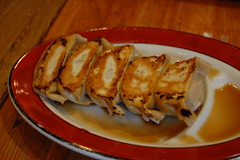
The gyōza were good, but nothing to write home about. I did find it interesting that the dipping sauce consisted solely of garlic, hot chile oil, and vinegar (rice, I think), with no hint of soy. In my extensive experience of gyōza (which I, having lived in Taiwan for more than a year, will always think of as jiaozi), soy is always sort of the foundation of the sauce, so this was new to me. Of course, on the bus home, it occurred to me that maybe you were supposed to add soy to this, as you have a soy sauce thing on your table already. I don’t know. It was fine, regardless, but as I say, nothing to write home about. You’ll note from the picture the standard Japanese way to serve them: you cook five or six pressed closely together in oil on a small nonstick fry pan, then add water about halfway up the sides and cover, and when the water boils off you pick them up, stuck together in a line, and serve them crispy-side up on an oval plate. I’ve never seen this in Taiwan, but everyone does it in Japan. I include here an example that wasn't from our lunch, but rather from "su-lin" photostream at Flickr, which is a pretty good representation of how they're usually presented at Japanese restaurants.

All told, Dragon Gate gets our thumbs up. It’s good Sichuan food, done well, at very reasonable prices. I’ll have to go for dinner some time and see whether the menu gets more extensive then, as is common, because I did think that the menu we saw was a bit short. In any case, if you like Sichuan food and are in Kyoto, they have four outlets, so try one.

Stumble Upon Toolbar