Showing posts with label recipes. Show all posts

Tuesday, April 14, 2009

Gefilte Fish Again, But Maybe Not So Jewish

After the Great Gefilte Fish Fiesta, we ended up with a lot of strong fish stock and two large gefilte fish balls. So it was time to cook with leftovers. This was a while back, just after the original gefilte fish thing, but I lost track of the photos, so this took a while to post.

The thing is, the Japanese don’t usually make stock in our sense of the word. Dashi, the basis of just about all Japanese cooked food, is made by extracting flavor from kombu (kelp) and often some sort of dried and salted fish product, most commonly katsuo bushi (salted, smoked, dried bonito in shavings). Taking bones and meat scraps and simmering them with some vegetables for a while is a similar process, but it doesn’t come up almost at all in Japanese cooking. That’s one of the ways you know ramen noodles are Chinese, not Japanese, in origin: the soup is stock, not dashi. So here’s me in Kyoto with a couple of quarts of great fish stock. What to do?

My first thought was one of those great Mediterranean fish soups: bouillabaisse, bourride, and so on. But I am informed that there is a special circle in Hell for people who eat these soups without crusty bread, so that wasn’t going to work. Passover has its down side.

Then I thought of Korean soup-stews. I surfed around the Internet to find some recipes, and eventually cobbled together something that seemed workable.

Passover Chigae

Here’s the mise en place for the stew, in no particular order. Chopped onions, slivered negi, two eggs, minced garlic, some shaved beef, cut-up gefilte fish, pack of fresh soft tofu, jar of kimchi, big bowl of stock (not all of which got used). Front-left, a little packet of spicy sesame miso, which I figured would be a decent substitute for gochujang, which is Korean spicy fermented soy paste. In the back, sesame oil, hot chile oil, and a bottle of kimchi juice, something you can get very easily here and which everyone apparently puts in chigae.
Gefilte fish chigae
In case you’re wondering, Sam and Maia got udon soup noodles, which are about as far from spicy as it’s possible to be.

First up, start cooking the beef and the garlic in some sesame oil.
Gefilte fish chigae
Add kimchi and a bit of kimchi juice.
Gefilte fish chigae
Add onion.
Gefilte fish chigae
When the stuff all seems basically cooked, add enough stock to make a thickish soup-stew. If you add a whole bunch, it gets watery, because the tofu will throw water of its own.
Gefilte fish chigae
Bring to a strong simmer, taste, and add a splash or so of hot chile oil and another of sesame oil. Then add the gefilte fish balls and return to a strong simmer. (In the normal Korean dish you’d add fresh seafood, you see.)
Gefilte fish chigae
Add the tofu in large cubes. You can also add the whole pad and kind of break it up coarsely, but the wife likes cubes. Bring to a boil, then reduce to a medium simmer.
Gefilte fish chigae
Now I added a couple Tb of the spicy sesame miso. In some Korean recipes, they add gochujang somewhere along the line, and in others you see shrimp jut, which I’m not quite sure what it is. There’s also something called guk ganjang, which looks a lot like gochujang in the one photo I’ve seen, but I have no idea. Anyway, I added the miso at this point because you generally don’t want miso to be boiled, only simmered.

Once the miso was mixed in, I cracked two eggs on top and sprinkled with the negi shreds.

Now cover, bring to the tabletop induction burner, and bring the temperature to a gentle simmer. Wait a minute or two for the eggs to just barely set, and...
Gefilte fish chigae
Ta da!

The Envelope Please...

Pretty delicious, a definite success. We got enough for four generous servings, easy, and the two of us polished off about two-thirds, so we were groaning a bit, fat but happy. It was spicy, but not blazing, with lots of complexity and depth. The gefilte fish chunks had a slightly odd texture for this stew, but mostly because we knew what they were in advance; I think if I had made gefilte fish with a little Korean twist along the way, such as a hint of garlic and sesame oil, it would have clicked perfectly. To top it off, the dish was disturbingly healthy, yet tasted like something self-indulgent.

A winner! Next time you have leftover gefilte fish, you know what to do.

Stumble Upon Toolbar

Wednesday, February 25, 2009

Fish Heads, Fish Heads

I'd like to share with you a classic Japanese home recipe that is cheap, delicious, exotic, and perhaps a little disturbing. Right up front, I'm going to call for help, though: the main ingredient isn't usually available as such in America, at least not on the East Coast, so substitution is necessary.


Brace yourself, some of this may get a little ugly.

Tai no Ara Taki (鯛のあら焚き): Bream-Bits Kindling

Tai (), or sea-bream, is the king of fish in Japan. It's got a distinctive sweet taste, and it holds up well in an enormous range of different cooking types: raw, poached, broiled, simmered, etc. Its many parts are generally good eating as well, and to top it off it's pretty. This one looks rather small; the big ones are a good 2 feet long.


Once you've gracefully removed the fillets from the bones, though, why waste a good thing? What you have left is the ara, the bits: head, collar, fleshy backbone. There's good flavor there, and firm meat, so let's make something good out of it.

The name of this dish, the bit about “kindling” (
taki), comes from the way it's cooked. Not that you light it on fire, but you put it on a bed of sticks of gobō (burdock) that look kind of like a pile of kindling. And then you simmer the heck out of the fish bits.

The end-result is a plate of bits with the head-halves on top, with a little
gobō as a garnish, in a puddle of thick, rich, brown sauce. You sit there with chopsticks—and pretty soon your fingers too—and pick all the succulent parts out of the bits.

Sound gross? You'd be surprised. It's delicious.

What's more it's cheap, easy, and fairly quick.

The Fish

The first step, of course, is to acquire your fish.
Tai aren't cheap, if they're any good, being the king of fish and all that. A big good one can run you more than $100 here... a lot more. But a decent one can be down around $25. You have to remember, from this you're getting two fillets as well as the bits for making this dish. One fillet you make into slices for the nabe pot, and the other you trim as sashimi, and all that's left is the bits, which you now turn into this wonderful side-dish. Here's one presentation of tai sashimi, which I had at Roan Kikunoi.

DSCN3311

Of course, in America you can't get tai off the West Coast, at least not that's really worth eating. Certainly I wouldn't make sashimi out of it. So you've got two basic choices: buy a whole comparable fish, or convince the fishmonger to sell (or preferably give) you the heads.

I'm betting that if you cozy up to your fishmonger, he'll just give you the heads, as they're garbage to him. If we all can figure out an appropriate few fish for the purpose, this makes the dish dirt-cheap. In Japan, you can buy heads and bits for this purpose, but in the U.S. they throw them away as a rule.

Which fish? Err... that's where it gets tricky.

You need a firm, white-fleshed fish: salmon (red) or mackerel (blue) won't work. Salmon doesn't have enough taste, and mackerel has too much. You want a head that has lots of bits of meat and flesh to eat, and here my encyclopedias and such are no use, because they don't talk about this very much. Maybe a relative of the sea bream (Pagrus major, red Pacific seabream)?

I don't know. I'm going to proceed from here as though you have a
tai on hand, and hope you'll try it with what's local and let me know.

The Head


So now you have a fish head. Ick!

No, wrong answer. The right answer is, "split it." Here's how:

CLICK THIS LINK

You now have your fish-head, split, possibly cut into medium chunks.

If you have a meaty backbone, shear off the part that still has skin up at the top and bottom. Then cut the backbone into chunks.

Put a big saucepan full of water over high heat and let it get close to a simmer, i.e. when little bubbles are definitely forming on the bottom of the pan and there is real steam rising. This is the point when you think, “it'll boil any second now,” creating the adage about a watched pot.

Drop in the fish, bring to a rapid boil over as much heat as you can, and then move the pieces into a big pot of ice water.

Once the fish is definitely cool, even cold, feel the surfaces all over for any blood clots or remaining scales. This is your last chance to scale, so make good use of it. A few scales are okay in this dish, but the fewer the better—and no scales is definitely excellence.

The Kindling


For one fair-sized tai head, you need one big or two medium stalks of
gobō (burdock), which you can get at a surprising range of stores these days. If unsure, get it from an Asian market, which is sure to have it. It should be cheap: it's a destructive weed in America, so eat lots. It looks like this.
和風牛蒡絲 (Japan Burdock)

Scrub the burdock, preferably under running water, with a coarse plastic scrubber like you'd use for a nonstick pan. You want to get all the dirt off, and it can be pretty deep.
DSCN4310
Cut the burdock lengthwise into quarters, then in about 2-inch lengths.

Rinse well in water and drain. Pour into a big, deep skillet or wide saucepan.
DSCN4315
Arrange the fish bits on top, with the eyes upward.
DSCN4318
At this point you can stop, cover the skillet with plastic, and refrigerate for a good 12 hours or so. Fish heads are perishable, of course, so you don't want to go too long, but this isn't a fine-detail sort of dish.

Cooking the Dish

About 60 minutes or so (and there is considerable latitude here to work earlier) before serving, add 400cc water and 400cc of drinkable sake. It doesn't have to be anything grand, but salted cooking sake is out. Put on a drop-lid, which should cover everything and be slightly covered with liquid. Add water if necessary.

For this I've used a folding drop-lid available at any hardware or home-good store here for about $2. You could also use a smallish pot-lid, a dinner-plate, or even a couple of sheets of paper towel. The dinner plate will be hard to lift, and the towel even more so, but all of these things work. The point is that this will hold the stuff under the liquid for a preliminary cooking.
DSCN4319
Now bring the heat to medium and wait until the stuff comes to a true boil—not just a simmer, but a proper boil. Remove the lid—you won't use it again here.

Skim the white scum.
DSCN4321
Add 5 generous Tb sugar and 50cc mirin; if you cannot get real mirin, as is likely, use 45cc sake and another Tb sugar—brown sugar would be lovely here. Shake the pan around a bit to distribute, and baste the fish with the liquid. Boil fairly rapidly—medium-high heat—until the liquid is reduced by about half, basting now and again.

Add 60cc soy sauce, or preferably
tamari, but either will do fine. Keep boiling until the liquid is starting to turn into a syrup, basting fairly often.
DSCN4323
Before it gets there, grate a big chunk of peeled ginger on the finest grater you've got, held over a bowl. Squeeze the gratings over the same bowl through a fine-meshed strainer. You should have fair bit of ginger juice.

When the liquid is turning to syrup, the bubbles will start getting fatter, the sound of the pan will change, and when you lift the pan and shake a bit, there won't be all that much liquid left.

Add the ginger juice and shake it around a bit, then baste vigorously as the sauce gets shiny and, well, sauce-like.

When it gets to this point, remove from heat. Put the bits in a soup plate or the like, garnish with a bunch of the burdock on the side in a clump or something, and then pour on the sauce.

Yum! Fish Heads!
DSCN4327
To eat, just pick up an appetizing-looking bit and eat anything that isn't bone, munching and sucking as you go to get all the goodness out.

I know, sounds gross, but honestly it's wonderful. And if you can get fish heads for free or very, very cheap, as I suspect you can, you can make this dish for very little. What's more, it can sit for days and be picked at cold, lukewarm, or nuked-hot; it won't be as good as freshly-made, but it'll be good.

Conclusion

Now I want all of you to run right out and try this. The big question is the fish: what's white-fleshed, firm, flavorful, and fairly local? If there's a choice, what will the fishmonger give you for free? Now make the dish and tell me how it tastes, and whether the flesh is still firm enough to make it worth eating. I want you to figure it out, because I'm going to come back to the East Coast and want to make this (my wife loves this), and I want somebody else to have done the experimenting to figure out the right fish for the purpose.

Stumble Upon Toolbar

Wednesday, October 8, 2008

Fun With Scallops

So I’m in Nishiki market buying a bunch of stuff the other day. Nishiki is this amazing place where you can get pretty much anything that appears in remotely traditional Japanese food. It’s a whole bunch of little stalls, most just 6-10 feet wide; this egg place is literally something like a meter wide, and the nice lady has to go into the back to get stuff for you because she doesn’t have almost any display space.
Eggs at Nishiki 2
Nishiki market runs for several blocks, covered, blocked off from traffic — and now also from smoking, which is a definite plus around food!

I’d already gotten pretty much everything I needed and I was just looking for something extra, some neat thing that wouldn’t cost too much but would be fun. And I spotted, way at the west end of the market, a guy who does mostly shellfish. He’s got this big tray of ice, on which he’s got live oysters and the most beautiful live scallops I’ve ever seen. They’re $4.75 apiece, which isn’t much considering they’re huge.
Scallops at Nishiki
Hey, I can shell a scallop — they say it’s the easiest hardshell to do, so I can learn from good instructions. I’ll cut them, then broil in the shell with some pollack roe, because scallops usually don’t have decent roe of their own and I want the richness without mayonnaise and cheese and stuff. The nice man carefully chooses three good ones and packs them into a paper bag with a little plastic thing of ice, puts that in a plastic bag, and I head off home.

So about 45 minutes before I want to serve dinner, it’s time to get those suckers out. I’ve read that you don’t do it more than an hour in advance because they don’t stay fresh. So, out come the scallops and a very, very sharp paring knife. This photo shows both: that’s a 4.5-inch blade, so you can see how big the scallops are.
IMG_3789
Since you almost never see scallops live in American markets, I’d never shelled one myself, but I knew what to do. Here’s the basics: You hold it right-side up, and since the mouth tends to gape you can just reach into the upper shell with a paring knife. You cut between the adductor muscle, which is the big part you eat, and the shell. This releases the shell, which you pull off, and then you scrape the bottom clean in the same way. You only eat the adductor muscle, which looks like what you think a scallop looks like: a white cylindrical blob. If there is red roe, you eat that too, but that’s not usual except in one or two Atlantic species. The rest you chuck.

You might think chucking that stuff is wasteful; after all, you’re chucking essentially 100% of the stuff you eat in a mussel, clam, or oyster. But this actually makes the scallop probably the safest bivalve to eat raw: the danger usually comes from the fact that you’re eating a filter, something that eats by sucking things (including nastiness) out of the water. But with a scallop, you only eat the adductor muscle holding the shells together, and you chuck the filter part. (Though in Europe and Japan they usually eat the whole thing.)

So, armed with this knowledge, I grabbed my beautiful scallop and my beautiful handmade knife. In goes the knife, and snap! The thing closes, hard. After a good bit of work, I extricate the knife. I’m not kidding: this thing was really gripping the knife! I try again, this time coming in from the side, where there’s a bit of a gap. I can get the knife a couple inches in, but to get farther the scallop needs to open, and it doesn’t want to. I don’t want to screw around here, because I don’t want to hack the flesh to bits, and besides that knife is frighteningly sharp, so if I slip badly I could literally lose a fingertip. Finally, working as carefully and quickly as I can, I manage to cut above the muscle enough that it starts to let go on one side, but it’s still fighting. Not wanting to kill myself with the knife by yanking or something, I shift to the opposite side, cut-scrape some more, and suddenly uuhhhh it lets go. Now scrape scrape scrape and it all goes in a little bowl for trimming later.

I’m thinking, okay, this is a mutant scallop, right? I mean, I have never had trouble like this with clams, mussels, lobsters, crabs, or whatever. Oysters I have only opened once, but there it’s just a bit of hard pressure and pop! So, on to the next scallop. It’s equally feisty. I’m expecting it, though, so I have a strategy, but it’s still a fight. Same with the final one. If that knife were blunt, I’d have shredded the meat just trying to open the damn thing, and god knows what I’d have done if the blade had been short.

Okay, so far so good. A little surprising, but at least they’re really fresh. Right?

Next I scrub the shells very well with soap, rinse thoroughly, and boil the hell out of them for ten minutes. This is because I’d like to use them as little dishes, you see. Once those shells have cooled and drained in a colander for a while, it’s time to trim the meat and get these puppies under the broiler. What with one thing and another (I had most of a meal to prepare at the same time), it’s been about 30 minutes since the shell fight.

I reach in to the bowl for one of my pals and scoop it out. Suddenly it sort of jump-pulses in my hand. It’s still alive and fighting! Now I’m getting a little freaked. Fresh, yes, but what they hell? I cut and trim as fast as I can, again with my very sharp knife, and it keeps pumping just when I least expect it. Finally I’ve cut enough that it stops moving — mostly: I can still feel it twitching just a bit as I finish up and dump it in a shell half. With some trepidation, I reach for the next... which starts throbbing. I’m expecting it, so I’m quicker, but it’s still weird. The last one, I’ve figured out what to cut first to stop it from jumping around, so it goes more smoothly, but it’s definitely alive.

Let me explain. When I say “jumping around,” imagine you’re holding a small frog or toad or maybe a big goldfish, gently but firmly, almost entirely enclosed in your fist. You thought it was dead, but now it decides it wants no part of whatever you’re up to and makes a break for it. Got it? Can you imagine it suddenly coming to life and starting to squirm? I know it’s just a muscle and a very simple nervous system, but it sure seemed like these scallops were trying to escape. I’m reminded of the heart transplant in the movie Airplane, which keeps bouncing up and down on the doctor’s desk.

Well, at least they’re fresh!

After all that excitement, the actual cooking part was nothing. I put one scallop each the three deepest shell halves and added two 1 cm slices of tarako, which is salted fresh pollack roe. Then a sprinkle of salt, a small dash of soy, and a squeeze of sudachi lime. I ran them under a sorta hot broiler about 3 minutes until the top was just opaque, the inside raw, the underside nearly so — I sure wasn’t concerned about freshness! Ta da, serve immediately.
Broiled Scallop with Tarako
Very good, I thought. Next time I’d add only one piece of tarako and something else, maybe a little sabayon or homemade mayonnaise or crème fraîche, to add a different, less salty richness, as the combination of richness and salt was a little too forceful against the subtly briny scallop. Cheese seems like overkill. Regardless, scallops this fresh are really fabulous. And at $4.75 per scallop for big honking diver-harvested things like this, I’d do it again in a minute.

I have since found that I did one thing wrong, and that there is a strong difference of opinion about another. The thing I did wrong: you always go in from the side, right by the hinge, not from the front, so the scallops can’t just clamp down on the knife like they did to me. The other thing: some people say you want a sharp knife like I used, but others say you want a butter knife and just scrape the muscle off the shell. That way you can’t shred the meat, you see, and can be pretty rough with the scallop. That system seems to be more popular with bay scallops, which are little, but it does get used with big sea scallops. Next time I’ll try both methods and see which works best for me.

Regardless, next time I’ll be prepared for a fight. Who’d have thought scallops would beat out crabs and lobsters for basic toughness and bad attitude?

Stumble Upon Toolbar

Saturday, September 20, 2008

Mexican My Way

We recently discovered that Daimaru, a big department store not far from us, has cilantro in its basement food court. Not pricey, either. I am still very confused about how difficult this is to find, but at least now I can get it. While there today, I also discovered that they stock fresh thyme, sage, and the like, so I am no longer so stymied on basic herbs.

I had decided to make Mexican food tonight, using some nice recipes from Diana Kennedy. Before I get to what I made, and how, and like that, let me continue my musings on odd absences and gaps in Japanese food availability.

Why No Mexican?
As I discussed recently, I find it mind-boggling that you cannot get basic Chinese ingredients without an extensive search; we ultimately did find things like fermented black soybeans at a Chinese specialty shop, but I still wonder why you can’t get them in an ordinary store. With Mexican foods, I understand that there is no established connection the way there is with China, but I nevertheless find it strange that this cuisine has so little presence here.

If you think about real Mexican food, not Tex-Mex, you note that it’s dominated by a number of basic ingredients: citrus, fresh herbs, tropical fruits and vegetables, rice, corn, pork, mild dairy products, and an enormous amount of seafood. According to Kennedy and other experts, Mexicans who are into food tend to be quite bonkers about seafood: fresh, local, and all that. Some Mexican foods are of course very spicy, because of the use of chiles in various forms and of many kinds, but this isn’t true of all Mexican food by a long chalk. In fact, it’s quite common to use some of the more intensely-flavored chiles only for flavor, not heat: in many Yucatán dishes, for example, you take habanero chiles, whole and uncut, and let them sit in a hot sauce for a little while, just to infuse the flavor but not to make the dish spicy at all.

Now the only thing I can see many Japanese people objecting to about this cuisine is the spicy thing. Not that there aren’t Japanese spice-maniacs, but certainly the majority of the food here is very mild on that score. Otherwise, this strikes me as exactly the sort of thing Japanese people would love: lots of fresh seafood and tropical vegetables, rice, mild cheese and cream, a little pork or chicken here and there.

But it’s not here. There are Mexican restaurants, but not many, and from the various reviews and descriptions I have read, they tend to be pretty mediocre. As far as I have found, there are something like five or six Mexican restaurants in Kyoto, grand total — and this is a city where restaurants pretty much dominate all other kinds of shops.

So if you’re reading this and you’re a serious Mexican chef, let me suggest that you could get in ahead of the wave. You focus on fresh seafood, you put occasional markers on your menu when something is spicy, and you avoid the things that have become American Tex-Mex commonplaces. Somebody is going to do this, and it’s going to be the next hot thing, the way Italian was quite recently. Go ahead: I bet you could do very well. If you make a fortune, cut me off a piece of it, okay?

Mexican At Home
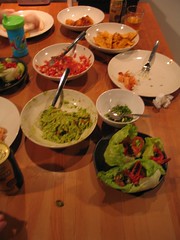
Based on what’s available and fresh — and what my son will eat — I decided to do two dishes and some little sides. I’d do a chicken-rice-vegetable one-pot thing, a great deal like what the Japanese call a zosui but with very different herbs and spices. I’d do a broiled sanma (Pacific saury) briefly simmered in a green, somewhat spicy sauce. And then I’d do some basic salsa, guacamole, and the like to use as salad/garnish.

The most interesting dish, and in some ways the most successful, was the fish.
sanma Mexican
Kennedy’s recipe calls for a mild, firm-fleshed white fish, like a sea bass. She has you poach it until barely done, use the stock to make a sauce, and then cook the fish in the sauce to re-warm and marry the flavors. I thought the fish would probably be overdone this way, and I don’t really like poached fish. So I decided to try a merger of Mexico and Japan.

First I made stock: I took the head and frame of a red snapper I had in the freezer from earlier this week, added some frozen vegetable trimmings from my box that I keep for the purpose (carrots, bits of tomato, onion, scallion, etc.), then added a bay leaf, a generous sprinkle of oregano, and half a yuzu, which is a very sour but floral local citrus fruit. I covered it with water, brought to a very gentle simmer, and left it there for an hour or so. Then I strained coarse, then fine, and had good fish stock. (Red snapper, or sea bream, Japanese tai, makes fabulous stock.)

Then I got a sanma (Pacific saury). I got it at Daimaru, rather than my local grocery store, because I was there and besides I wanted something really good. It had already been lightly salted, so I just rinsed it off.

To make the sauce, I put a bunch of stuff in my immersion blender jar and processed until smooth. (See recipe below.) About 15 minutes before dinner, I sauteed garlic, added the sauce and simmered rapidly over medium heat. Then I cooked the fish.

To do this, I used the Japanese shio yaki style. I rubbed the fins with salt, then put the fish under the broiler until very brown and crispy on one side, flipped the fish with chopsticks, and broiled the other side. I now put the fish onto a plate, remove the whole garlic cloves from the sauce, and poured the sauce over. You can see the results: visually pretty cool, I thought.

The flavor was excellent. I think the shift from a mild fish to a dark-fleshed one required more chile and perhaps more cilantro — certainly it needed a bit more salt in the sauce to stand up to the salty fish. Other than that, it was very good. I did think the sanma liver (you grill these things whole, ungutted) was rather bitter, but I am informed that this is usually the case and not my fault.

I’d do it again, no question. But I think I’d use (a) a milder white-fleshed fish, like a small red snapper, (b) more cilantro and salt, and (c) at least double the amount of chile. Then I could serve it with plain rice and something mild for salad and have a pretty wow dinner.

I do think that if I didn’t do the extra chile, the resulting dish would be very much to the taste — visual as well as palatal — of a lot of Japanese people. The sauce is exciting and complex, but it doesn’t overwhelm the fish at all, which would be the big objection. I think it could have been garnished with a little minced tomato, in a line down the fish, for prettiness’ sake, but the intense green and the crispy whole fish made a great combo.

One thing I do need, as you see, is better dishes: this should not have been put on a blah round white plate. Oh well — I am, after all, in Japan, where beautiful handmade dishes are surprisingly inexpensive. So maybe soon I’ll start upgrading my presentations.

The Recipe
[To serve 2 as a main course with salad and rice]
Ingredients
1 pound fish frames for stock
2 cups stock vegetables: carrot, turnip, onion, tomato, celery, etc. trimmings
1 tsp dried oregano (or 3 sprigs fresh)
1 bay leaf
1 large wedge sour citrus, preferably lime or similar
2 smallish whole fish (Spanish mackerel, trout or bass, whatever looks good)
1 cup coarse salt, e.g. kosher
1/4 cup blanched, peeled almonds
1-2 whole hot chiles, e.g. serranos
2 Tb capers, drained
1/3 cup unflavored bread crumbs
4 lettuce leaves, torn coarsely
1/4 cup onion, chopped
10-15 sprigs cilantro, coarsely chopped
4 cloves garlic, peeled
1 Tb cooking oil
salt and pepper to taste

Method

Put the frames, vegetables, oregano, bay, and citrus in a small saucepan and cover with cold water. Bring slowly to a simmer, and simmer gently for 1-2 hours, skimming any scum that rises. Strain coarsely, then very fine, and reserve. You should have about 2 cups.

Rinse the fish and scale if necessary. Rub all surfaces lightly but thoroughly with coarse salt and let the fish sit on a countertop for about 30 minutes.

Put the almonds in a blender and process until as smooth as you can get them. Add 1 cup of the reserved stock and process again, scraping as necessary, until very smooth. Add all the remaining ingredients except for 2 cloves garlic and puree until very smooth. If it seems very thick, add 1/4 cup more stock and puree. Salt generously to taste.

Rinse the fish all over and dry well with paper towels. Rub all the fins, the head, and the gill flaps generously with coarse salt.

Put the oil in a wide saute pan and heat. Add the 2 reserved garlic cloves and saute until just golden. Add all the sauce, plus another half-cup stock, and stir gently. Let simmer 15 minutes; if it gets too thick, add more stock.

While the sauce simmers, turn the broiler on full-blast. Set the rack to be about 5 inches from the flame, and oil the rack very well. Put about 1 cup water in the bottom of the broiler pan, which will help with the cleanup immensely. Put the rack under the flame for a couple of minutes before adding the fish.

Put the fish on the rack, lying on their right sides (if the head is to the left, the belly should be toward you). Broil 3-4 minutes, until the skin is very brown and crisp, and bubbling up in places. (Adjust the rack distance to get this effect in this time.) With chopsticks and/or rubber or wooden spatulas, gently turn the fish over — tongs don’t work. Broil another 3-4 minutes on the other side, until brown as before.
sanma shio yaki
Turn the fish again and remove, with a wide spatula or two, to serving plates. The sauce should be ready: remove the whole garlic cloves and pour over the fish. Serve at once with plain rice and a simple, fresh salad. Chips and fresh tomato salsa are an excellent side with this.

Total cooking time: 3 hours, including stock-making, which can be done a day in advance
Total active cooking time: 30 minutes

Stumble Upon Toolbar

Sunday, September 14, 2008

Chinese Weirdness

I was getting rather tired of Japanese/French semi-fusion food, which I have been doing for the last few days. I think I first realized I was getting tired of it when I plated a sanma (Pacific saury, very similar to a small mackerel or a large sardine) tartare in a perfect cylinder topped with an even layer of salmon roe, garnished with a vinaigrette sauce adorned with capers and chopped hard-boiled eggs, and thought I should probably photograph this for the blog---and then thought, "ah, what the hell, too much trouble." This despite the fact that I got this recipe from Le Bernardin's cookbook (the 4-star fish restaurant in New York), made some fairly clever substitutions based on availability in Japan at this season, and all in all made something that was perfect for blogging. Turns out, I was getting tired of this. Why?

All that protein, I guess. I mean, you've got fish, and more fish, and eggs, and then vinegared stuff to brighten the flavors... but where are the veggies? Turns out, the Japanese are on the whole kind of bad about this. They do eat some vegetable superfoods, like fresh soybeans (edamame) and various seaweeds, but they're really not great about fresh vegetables in general. They'd rather pickle them, which is fine but gets us right back to the vinegar and salt thing.

Well, since I now have a passable sense of what I can get in the local market, produce-wise, I went to my cookbook collection (which has now arrived, thank goodness). I was sort of idly turning pages, flipping through different books, but nothing seemed very appealing. And then... my eye happened on Barbara Tropp's wonderful Modern Art of Chinese Cooking. Oh yes---Chinese stir-fry! Bright flavors, handled quickly and intensely. And I should be able to get everything very easily, this being East Asia, after all, where the influence of China has been almost overwhelming for a very, very long time.

So I went on a shopping expedition and found...

Huh?

Wait just a second. I'm in Japan, right? I'm in what is probably the culinary center of Japan, where every other shopfront is a restaurant and people are absolutely stark, staring bonkers about food. I'm in a place where people will pay as much at a good Chinese restaurant as they'd pay at a good French restaurant.

But I can't get cilantro. I can't get black soybeans. I can't get Chinese-style roasted sesame paste. I can't get Chinese wine. I can't get hoisin sauce. I can't get Sichuan peppercorns. What the hey?

A Little Rant
If you don't know much about Chinese cooking, or about Japanese history, you may not see why I think this is quite as bizarre as I do.

The first point is that almost everything in Japanese aesthetic history really starts with China. You constantly see all sorts of stuff about how distinctively Japanese is that stuff about empty space, simple wooden architecture, paper shoji screens and tatami mats, and so on. But all of that is very closely patterned on certain dominant aesthetic trends in China in the Tang dynasty, when the Japanese first had really extensive and intricate intellectual exchanges with China. In theory, this is when Buddhism came over to Japan; almost certainly it arrived earlier from Korea, but from the Japanese perspective it's all China. The same thing goes for the writing system: the Japanese writing system is adapted from the Chinese, using the same characters (kanji) plus a series of wildly simplified characters that serve as a syllabary (the kana).

The second point is that many of these ingredients are not only common in Chinese cuisine, but elsewhere. Cilantro is native from southwestern Asia to north Africa, but it has been spread around the globe. Wikipedia notes, correctly, that cilantro or "coriander is commonly used in Middle Eastern, Mediterranean, Indian, South Asian, Latin American, Chinese, African and Southeast Asian cuisine." Note the odd man out: Japan. Yet beyond so-called traditional Japanese food, some of the most popular kinds of restaurants in Japan are Chinese, Mediterranean, Indian, and Southeast Asian. What's more, there is the longstanding connection between Japan and Brazil, where once again cilantro is very popular (it is essential as a final garnish on feijoado, the national dish).

Beyond cilantro, let me note that Sichuan peppercorn is actually the same plant, so far as I can tell, as what the Japanese call sansho, the only difference being that the Japanese generally use the green leaves while in Sichuan you use the dried berries in their husks. If you're cultivating the plant, why isn't it available?

A really irritating example here is fermented black soybeans. The Japanese love fermented soybeans--see my experimental discussion of nattō. The Chinese black beans are prepared a bit differently, but I cannot imagine that many Japanese would not like the taste. In fact, I know for certain that seafood steamed or stir-fried in black bean sauce is extremely popular in Chinese restaurants here. So why can't I get the stuff?

I could see it if I were talking about ingredients that don't keep well or something, and perhaps that is part of the problem with the cilantro, though I rather doubt it. But everything else I'm talking about keeps for years. Literally: you can buy a vacuum-sealed package of black beans and not open them for a couple of years, and they'll be just fine.

Now I'm sure I could get Chinese wine (Shaoxing wine, for example) if I wanted it, if I just scoured the local liquor stores. But this is easy to substitute: if you're not using very much, sake will be perfectly acceptable. But the other things are not something you can work around: you cannot make something steamed in black bean sauce without black beans.

I decided to say what the hell and make what I could, with some appropriate substitutions insofar as I could get away with it, and the results were pretty good. But I remain mystified.

If any reader can tell me what's going on here, why I cannot find the most basic Chinese ingredients after searching several fairly large grocery stores, I will be very grateful!

Chinese Dinner At Home
For some reason I haven't been in the Chinese-cooking mode for a while now, and I'd forgotten how much fun it is. You can do almost everything difficult well in advance, and you plan around what burners and stuff you have. At more or less the last minute you whip it together, with lots of panache and clanging and general fun--if you're stir-frying in a wok over very high heat, you can also get some nice flare-ups which are exciting to watch--and you can quickly dish up a whole bunch of different things. What's more, almost everything keeps, and can be eaten cold, or reheated, or whatever; if there's something that doesn't reheat (like clams or something, for example), you just tell your family they have to finish that one off.

My only disappointment with cooking Chinese now is that Sam won't eat things that are spicy, which puts a damper on my enthusiasm for Sichuan and Hunan cuisines--an enthusiasm shared by Tropp, which is another reason I adore her cookbook. (Tropp died tragically young in 2001, and so far as I know only completed two cookbooks: The Modern Art of Chinese Cooking and then the China Moon Cookbook. If you don't have the first one, get it!)

Still, I managed a few dishes, despite all: Don-Don Noodles, Ma-La Chicken, Wine-Explosion Vegetable Soup, and fry-steamed Jiaozi dumplings (for the latter, I used frozen premade, I'm afraid, and they turned out to be not great).

Don-Don Noodles
I love this kind of flavor: bracing, intense, and complicated, with a heady waft of spice. It's typically Sichuan, I think, and couldn't be easier to make. In fact, I made the entire shebang in advance, then nuked it, because I didn't have an extra burner to use.

There are two components: noodles with carrot shreds and peanut sauce.

I used udon noodles, which are good and plentiful here (and I had a zillion packets of really good ones in the freezer), but at home I'd go with the Chinese preference for fresh egg noodles. Whatever you use, you need it to be firm, bouncy, and preferably a little assertive, but don't worry if they turn out a bit wimpy: no self-respecting noodle is going to stand up to a sauce like this. I boiled the noodles until a bit underdone, then drained and rinsed in cold running water until quite cool, then drained again. Then I added 2 Tb toasted sesame oil (you need the Chinese or Japanese stuff, which is brown, not the "cold-pressed" or middle-Eastern stuff that is more or less clear) and tossed until all the noodles were coated. I took two medium-fat carrots, peeled them, split them down the middle, put them cut-side down on a board, and then used a vegetable peeler flat to the board to shave them into thin slices. These slices I stacked and set up more or less parallel, and with a knife cut them into fine julienne. I tossed the carrots with the noodles, covered with plastic, and refrigerated. You can leave them like this for 24 hours or more without any problems at all. To reheat, I just nuked them on medium-high power until they were warm-to-hot throughout.

To make the sauce, put 10-12 fat cloves of garlic (peeled) into the food processor and whiz, scraping down a couple of times, until semi-fine. Add about a bunch of mitsuba and some shiso leaves, all chopped up coarsely; in a sane world, just add a medium bunch of cilantro, coarsely chopped. Whiz on pulse again, scraping down often, until the whole thing is pretty fine. Now add half a cup of peanut butter (the organic kind that separates is infinitely superior) and whiz briefly to combine. Add half a cup of good soy sauce, a few Tb sugar, a small dash of sake (you should use Shaoxing wine, or maybe good dry sherry, but again...), and a couple Tb hot chili oil (try to get the kind that has scary red goo on the bottom of the jar, which I find tastes and mysteriously keeps better). Whiz, scrape, whiz, scrape, and continue until it's all pretty smooth, which doesn't take long. Taste: if it's intense but not exciting, add another Tb sugar and whiz again. Don't overdo the chili oil, as it will get hotter as it sits. Scrape the mix into a small bowl, cover with plastic, and let sit on the counter for a couple of hours. Refrigerated in a sealed tupperware, it'll keep for a very long time, but be sure to let it come to room temperature before serving.

To serve the dish, just plop the noodles down on a plate and top with the sauce, or have your guests add as much as they like. To eat, you sort of toss up the noodles and sauce (and carrots, obviously) with your chopsticks until it's all more or less combined, and then eat. If all has gone well, it will seem very mild-mannered for a bite or two, and then creep up and belt you one between the eyes.

My version was just fine, but lacked that high fragrance of the cilantro. I also thought the chili oil was wimpy.

Ma-La Chicken Cold chicken salad garnished with special hot-spicy-numbing oil. Came out a treat, I thought, and again, couldn't be easier. The only pain is the plating, and you don't have to go in for the silliness I did -- I just felt like it, okay?

There are four components: cold raw veg (usually cucumbers), cold blanched veg (asparagus, green beans, longbeans, whatever -- usually green, though), cold moist-poached chicken (breasts are better for this, but it really doesn't matter much), and the special oil. Then you have some dressings, for which my favorite is a sesame-paste one or the coriander dressing I used in the noodles (make extra and these two dishes are easy -- but a little repetitive).

The cold raw veg is... cold and raw. That was hard. Just slice and arrange.

The blanched veg: I used asparagus, as I say. Cut the pieces about 1-2" long, preferably at an angle, rolling a quarter-roll around between cuts so the ends are not parallel. Blanch asparagus about 1 minute in very fast-boiling water, beans maybe 90 seconds, and so on, just until barely cooked but very crunchy. Immediately shock in ice water, then drain and chill until serving time. To serve, put in a wide mound in the center.

The sesame paste sauce is a breeze with an immersion blender. Put a few Tb Chinese sesame paste (which is brown) in a small bowl. Add a Tb or so sesame oil, soy sauce, tamari (only the best brands -- check, because many are not tamari at all but rather colored pseudo-soy), sugar, and hoisin sauce, and a generous dash of hot chili oil. I replaced the sugar and hoisin sauce with a couple Tb tonkatsu sauce, which is sort of a mediocre variety of sweet hoisin -- this is kind of like replacing canned tomato sauce with ketchup, but it works. Whiz the whole works until smooth, add a tiny dash warm water and whiz again, and then taste. It should be thick but pourable. Let develop, covered, on the counter for a few hours. Keeps more or less forever in the fridge, but again, bring back to room temperature before using.

The chicken is a special Chinese trick. Get one chicken breast, on the bone, with skin. Take some slices of ginger, preferably spanking them firmly with a cleaver-side or tenderizer to open the pores, and put them in a little pot. Add some scallion chunks, spanked. Add some Sichuan peppercorn if you can get it, which I can't, as you know. Garlic doesn't work here, I'm afraid. Fill the pot up about 1" from the rim, cover, and bring to a rapid boil. Meanwhile, go over your chicken breast and remove any bloody bits or other nastiness. When the water is boiling fast, turn off the heat and immediately slide the chicken into the water. Poke it under with a fork or chopstick or something and cover the pot. Leave for at least 2 hours. When you're ready to serve, pull out the breast, peel off the skin, and peel the meat in one piece off the bone (it will come pretty easily). Put it flat on the board and slice at a steep angle against the grain into thin slices. The meat will be just cooked through and extremely moist. Mound it prettily on the asparagus or whatever.

Before you actually start slicing anything, though, put a few Tb each plain cooking oil and roasted sesame oil in a very small pan. In a small prep bowl, put a few coins of fresh ginger, a tablespoon or so of scallion rings, a dash of Sichuan peppercorns (I used powdered sansho), and some dried chili flakes or a couple of whole dried chilies. Swirl the oils to mix, add one ring of scallion to the oils, and place over medium heat. When the scallion starts to sizzle pretty well, remove the pan from heat and add the contents of the prep bowl. Shake-swirl to mix it up, and then put the bowl off heat somewhere to develop flavor. When the salad is all plated up, the oil should still be warm but not broiling hot. Remove the ginger coins with chopsticks, add a small dash of soy sauce and swirl to mix, and then immediately pour the whole mixture gently over the top of the chicken, making sure most of the various chunky things in the oil remain on the chicken.

My version was pretty decent, but the chili flavor didn't develop well. I think I didn't really heat the oil enough, for one thing, and next time I'll also break open those whole chilies and shake out the seeds, to see if that works. The special Sichuan peppercorn flavor wasn't there, but that's the fault of Japan. The sesame sauce was pretty decent, I thought, but there wasn't enough of it. I didn't like the mustard sauce I made, so I won't give a recipe.

Soup
Was soup. Good soup, but soup. Basically what you do is you prep all your vegetables, and divide them into those requiring more cooking and those requiring less. You have good chicken stock on hand, and you whisk up 4 Tb cornstarch in 6 Tb cold stock or water for every 6 cups of stock in the soup; that is, for each cup soup stock, mix 1 Tb stock and 2 tsp cornstarch. Leave the spoon in the mix, as it will quickly settle out again. Whisk an egg white, whole egg, or two egg whites (up to you: it depends how much egg thread you like) in a small bowl, just until more or less smooth, not frothy.

Heat a big pot quite hot over medium-high heat. Add 1 Tb or so oil and swirl to glaze. Add a few Tb rice wine (I had to use sake, which is much too mild for this, but what the hey), which will immediately flash into a boil. Instantly add all the plain stock: I used about 6 cups. When it boils, add the veg for long cooking, bring back to a boil, lower heat, and simmer a minute or two, stirring occasionally. Add the veg for shorter cooking, stir, and cook a few minutes more. Turn the heat very low. Taste for seasoning, and add salt as needed. Add sugar too: if the flavor seems flat, add sugar to brighten mediocre vegetables. Whisk up the cornstarch mix again and add it, then stir constantly and gently for a couple of minutes until the soup turns glossy and just a bit thick -- it won't really clarify, but you'll notice its texture changing dramatically. Now pour in half the egg in a gentle circle, wait a second, stir gently, then pour in the rest the same way, wait a second more, and stir again gently. You should now have floating threads of barely-cooked egg. Serve the soup immediately, garnished maybe with a little finely-cubed ham.

Personally, I think this soup was a little blah -- the blurry photo does it justice, I guess. Maybe I didn't add enough sugar, but I think it just wasn't cool enough to hold its own against the noodles and chicken. I think it maybe needed something with a little brightness, or maybe just a dash of soy, or... maybe decent Chinese rice wine instead of Japanese sake? Could be: the sake just seemed insipid and bland, whereas nobody ever called Shaoxing wine, even the really cheap stuff, bland. I do think a generous sprinkling of white pepper might have lifted it, but Sam wouldn't have touched it. To be fair to the soup, he did eat quite a fair helping of it, so I guess maybe it's a matter of taste.

Concluding Request
In any event, this is a serious cry for help, as Bernie the Agent said to Kermit the Frog. Can somebody please explain to me why the hell I can't get basic Chinese ingredients in Kyoto?

Stumble Upon Toolbar

Friday, September 5, 2008

Simmered Mackerel -- Saba no miso-ni

Before I left the US, I'd already decided I was going to do this blog, so I asked some people what they might like to see in it. A couple of people said "recipes!" pretty forcefully, so here goes.

Mackerel is very popular in Japan. Technically most of it, called saba, is Spanish mackerel, which is considered by Western gourmets to have a milder, more delicate flavor than its Atlantic cousin. It's a fairly small fish, perhaps 18 inches long and quite narrow. It's got dark, somewhat oily flesh, and you have to be a little careful to avoid it becoming "fishy" in the unpleasant sense. The most important part of that, of course, is to buy it extremely fresh, which isn't difficult to do here as its prime season is August-October.

You can eat it raw, but it's unusual to do so; when you have it as sashimi, it's normally very lightly pickled, which is to say you fillet it, peel off the outer skin, and rub it with very mild vinegar and a little salt. 15 minutes later, you rinse it off and it's ready to slice. If you've had mackerel at a sushi restaurant--which you probably have if you've had much sushi, as it is not expensive and it holds up to cold-storage quite well--you've had it in this pickled form, though probably it was pickled longer and harder than this.

What people do at home, though, is different: you make saba no miso-ni (鯖のみそ煮), which is simmered mackerel in miso. When I first spotted these things looking great in the market, I had my wife look up what to do with it, and she found more than 100 Japanese recipes online... and then discovered that almost all of them, like literally 85-90 of them, were for this dish.

I decided to serve this with fresh tofu and yuba (湯葉 soymilk skin) from the local tofu-maker I just found, served chilled with garnishes (hiya yakko); rice (always); and then a stir-fry of okay-looking broccoli because I thought we ought to have some veggies.


Here you can see everything that went into dinner. Front and center is the little plastic dish of yuba, still in its protective bath of soy milk. Clockwise from this, the broccoli stalks sliced medium-thin, cut bite-sized; my mediocre vegetable knife that I use for everything because I haven't got anything better; the tofu (silk style, very soft), cut in cubes and bathing in ice water. In the metal bowl are the chunks of mackerel fillet, which I've blanched very briefly and then are soaking in ice water. Soy sauce, the broccoli florets, a mixture of miso and mirin (sweet cooking sake), julienne negi (giant scallion/leek) for garnish, a bowl of julienne ginger and chunks of negi (which you can't really see here), and then a bowl of shimeji mushrooms. Behind the yuba are, left to right, two cloves of garlic, a shiso (perilla) leaf, a stub of very young ginger, and some thin rounds of negi. In the very back you can see Maia's bum, which did not go into dinner.

Miso-Simmered Mackerel (Saba no miso-ni)

Ingredients

To make the mackerel itself, you need (for 2 people) a medium-sized mackerel. This dish is quite filling, especially as you're serving it with rice, and it's really not necessary to use more. But on the other hand it is extremely easy to make, so it's a good thing to serve to a small crowd if you can get the mackerel filleted. I bought bone-in and filleted it myself, functionally but not well--I'm working on that one.

Then you need:
1 knob ginger
1 negi (giant Japanese scallion/leek)--I'd substitute 4 fat scallions
a cup or two of mild but firm mushrooms, like shimeji, shiitake, etc. (optional)
600 cc (3/5 US cup) water
2 Tb sake (cooking sake is adequate for this)
1 1/2 Tb sugar
1/2 Tb soy sauce
2 Tb miso (use the medium-amber stuff, not red or brown)
1 Tb mirin (sweet cooking sake)

(The mushrooms are an optional addition to the mackerel. You could also use various other similar things that will stand up to serious simmering and retain some flavor and firmness. You don't want greens or anything else that will strongly flavor the sauce, which is why again mildly flavorful mushrooms are perfect. I bet you could find a way to do it with eggplant chunks, too, though I've never seen this.)

All of this is easily available in grocery stores all over the US, even in rural Vermont, because it keeps well. The only thing that may be troublesome is miso, but if need be you can order this on line. It stores almost forever in the fridge so long as you keep the surface covered with the plastic that comes with it and the lid on the box.

Preparations

To prepare, cut the mackerel fillets into large bite-sized chunks, about the size of a piece of nigiri sushi, if that helps. Cut an X about 1 inch in each direction, just barely through the center of the skin, to prevent the fish from curling as it cooks. Bring a medium pot of water to a rolling boil, and set up a big bowlful of ice water next to the stove. Put one or two pieces of fish skin-side down on a wide slotted spoon or spatula (a spoon is easier) and dunk the fish into the water for about 2 seconds, then immediately drop into the ice water. Repeat until all the fish is in the ice water. This process helps remove any lingering fishy smell.

Cut a bunch of 1 1/2-inch julienne of the white of the negi, for garnish. Cut the rest of the negi into 1 1/2-inch lengths. Cut the ginger into a skinless block, then cut planks with the grain, then stack the planks and cut into fine julienne. If using mushrooms, clean and cut or tear into bite-sized pieces.

In a fairly small heatproof (e.g. Pyrex) bowl, put the miso and the mirin and stir until more or less smooth.

At this point you can leave everything for a while, but you really ought to cover the negi and ginger with plastic and put into the fridge. If you're fast with a knife, it would be better to cut these aromatics at the last minute. The fish can wait in the fridge, under the cold water, for a couple of hours.

Cooking

Put the water, sake, and sugar in a saute pan or saucepan, ideally just wide enough to hold all the mackerel in one layer. Put the bowl of fish, a dish with the soy pre-measured, the bowl of miso/mirin paste, and the bowl of negi chunks and ginger (and mushrooms, etc.) within easy reach. Have ready either a curved lid for a pot one size smaller than the saute pan, which can therefore sit easily on the bottom of the pan, or a circle of parchment paper that again will fit inside the saute pan; if you're used to using parchment lids for braising, note that it is not necessary to make a vent in the center. You also need a smallish ladle and a big slotted spoon. Pick out a deep serving dish and put the negi garnish next to it.

Put the pan over high heat and bring to the boil. Add the mackerel, skin-side up, and boil about 5-10 seconds. Add the soy and shake gently. Turn off the heat. Tip the pan a bit, and scoop a few ladlefuls of the hot liquid into the bowl with the miso/mirin paste. Stir this paste mixture thoroughly, dissolving the miso completely. Pour over the fish in the pan. Add all the negi chunks and the ginger, scattering them more or less evenly over the fish. Turn on the heat to medium-low, put the lid over the top of everything, and let simmer 10 minutes.

Note that this whole process should take very little time--the quicker the better. Once you understand what's involved, you'll see that the whole procedure can be done in under a minute without much trouble. It's not a problem if it takes a couple of minutes, but the fish and liquid must not be allowed to cool significantly.

Remove the fish with the slotted spoon and put in a shallow mound in the serving dish. Cover this with the negi chunks, ginger, and any mushrooms or whatever that you may have added. Pour the liquid gently over the top. Garnish with the white negi julienne and serve immediately.

Serves 2 people. Total cooking time, 12 minutes. The dish multiplies well.

Note that this technique of dropping a lid into a pot is very common here, because braising on top of the stove is an extremely popular technique (dishes made this way are called nimono). Traditionally, you use a wooden lid just a hair smaller than the pot, and float it on top.

Cold Tofu (Hiya Yakko 日や奴)

Personally, I wouldn't bother making this at home, because the tofu is almost always dreadful, but some people like it--and some probably have access to truly fresh tofu. It couldn't be simpler: ice-cold silky-smooth tofu with a little garnish.

Ingredients
1 pad super-fresh silken tofu
best-quality soy sauce
negi cut in fine slices
fresh-grated ginger
small wedges of very sour citrus (yuzu, sudachi, kabosu, lemon, lime...)
mild aromatic leafy herbs, in chiffonade (shiso, parsley, perhaps basil...)
white sesame seeds
high-quality bonito flakes (katsuo bushi), shredded

All you need is the tofu and the soy. Pick as many or as few of the rest as you like, based exclusively on what is very fresh and perfect.

Method

Fill an attractive serving bowl with ice-cold water; it can have some ice in it, but not much and not big cubes. Rinse the tofu very gently in cold water (if it's really super-fresh, made in the last couple of hours or so, just remove it from the water it's in) and place on a plate or a plastic cutting board and cut into medium cubes. Transfer the cubes carefully to the ice water, which should just cover the tofu. Place in the fridge until ready to serve.

Each guest gets a pretty saucer. Within reach should be some sort of attractive dish with all the garnishes, carefully separated and nicely presented. Put the tofu in the middle, in its water, and provide a wide, shallow spoon, ideally finely slotted, to serve. Each guest takes a piece of tofu, puts a little soy on it and sprinkles on a little of whatever garnishes he feels like, then eats it.

Note that I only have mediocre-to-bad dishes, so this doesn't look nearly as good as it tasted.

If you have ultra-fresh high-quality tofu, this is lovely. If you have the usual stuff I can find outside the Asian markets at home, this is pretty mediocre, shading toward nasty. If your choice is between super-fresh firm tofu (the usual Chinese preference) and the stuff in a box or made by some hippy-dippy moron and packaged two weeks ago, go with the firm stuff. All tofu should be labeled to tell you when it was made. If it wasn't made in the last couple of days, skip it.

Chances are, if you're horrified by this dish and thinking, "that's nasty," you've never had halfway decent tofu. It's not so easy to come by in the US.

Additions

I just found our local tofu maker, and I bought some tofu about two hours after she'd made it. I also bought some yuba, which is soymilk skin (on the left in the picture above). Let me explain.

You make tofu by making soy milk, heating it, and adding nigari, which is actually a general term for a number of different chemical compounds (ideally the naturally-occurring forms, but it's all pretty harmless and used in very small quantities). This makes the milk curdle, like cheese. You drain the curds and press them in a cheesecloth-lined box, and this makes tofu.

Now when you heat soy milk, it's just like milk: it tends to form a skin on the top. So what you do is, you very carefully lift this skin off like a sheet, and you hang it briefly to firm up, and then you fold it or roll it and put it in a little cold soy milk so it won't dry out. This is yuba.

Kyoto is sort of the center of the universe when it comes to yuba. I mean, Kyoto-ites will tell you they're the center of the universe for a lot of things, of course, but even in Tokyo everybody knows that the best yuba is in Kyoto. There are shops that specialize in the stuff! I just bought it from the tofu maker, but it was really good. It's soft enough that you can sort of cut it with chopsticks, and then we ate it pretty much the same way as the hiya yakko. Wow!

Stir-Fried Broccoli (ブロコリのスターフライ)

Ingredients
1 fat head broccoli
2 Tb canola oil, in all
1 Tb soy sauce
1/4 cup water
pinch salt
2 cloves garlic, minced
a little sesame oil

Method

Cut the florets off the broccoli. Cut the stalks into medium-thin planks, then cut in half or so to produce bite-sized pieces. Heat a wok or an unlined skillet over maximum heat until very, very hot. Add 1 Tb oil and swirl around. When it smokes, in a few seconds, add the sliced stalks. Toss constantly for about 30 seconds to a minute, until you start to see a little browning happening. Add the soy sauce and the water in one go, swirl the pan to distribute, and let it alone. In a minute or two, when the water has almost completely boiled off and the broccoli is starting to fry, add the remaining oil and toss to distribute. Add the florets and a pinch of salt. Toss constantly for 30 seconds or so, until very bright green. Add the garlic and toss for another 15-20 seconds, until very fragrant. Pour into a serving dish and garnish with the sesame oil.

If the broccoli is fresh, this is wonderful. You can also add a pinch of dried hot pepper flakes with the garlic--I love that, but then my son Sam wouldn't touch it. Oh well.

Stumble Upon Toolbar

Tuesday, August 26, 2008

After Some False Starts...

... I’ve finally gotten ready to start putting this blog up.

As it says in the description, I’m an academic, foodie, and passable home cook. I’m on sabbatical this year in Kyoto, along with my wife, who speaks Japanese (which I don't) and is teaching this year; my son Sam, who’s 3 and will be in nursery school; and my daughter Maia, who’s not yet 1 and will, we hope, be doing some daycare. So I have quite a bit of time on my hands, and I thought I’d indulge myself and get serious about cooking and eating.

(As you can see, Sam and Maia both like the local cuisine.)

Kyoto is often said to be the culinary heart of Japan, although these days Osaka has a pretty strong claim. The deal is, according to Kansai-area foodies, that Osaka is great for earthy, robust food, and Kyoto is more about subtlety and elegance. So this is where you get things like kaiseki, the rarefied cuisine of lots of little tiny dishes delicately prepared and subtly balanced to harmonize with the seasons and so on. I’ve never been a big fan of the whole simplicity thing, as you’ll discover, so this is a good opportunity for me to break some habits and learn something new.

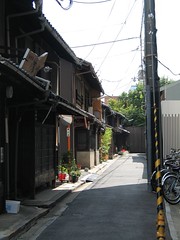
Now on the subject of false starts, the first thing was that our rented machia house (at the end of this street, on the left) came with almost nothing: a really horrible knife, two battered nonstick pans, and some mediocre dishes. So we headed out to buy stuff. The problem was that nobody seemed to know where to go. The staff at my wife’s office said to try Daimaru, a local department store that’s supposedly having some sales, but we were appalled by the prices. I mean, seriously: who’s going to pay $250 for a basic soup pot? — and, no, it wasn’t anything fancy either. Rubber spatula for $30? You've got to be kidding.

Then we heard about Muji (無印), or “no-name,” which we did. Things were a bit pricey, on the whole, but the quality seemed good and we found quite a lot of good stuff. The 100-yen shops had some really rock-bottom basics, too, but I still didn’t have a curve-sided pan or wok, for example, or a lot of other things. Finally we heard about Kawabata Nikku (川端ニック), which is up in the northeast, and that covered almost everything. So it took a week or so just to get some basics.

Turns out, incidentally, that restaurateurs don’t do what we did at all. In Tokyo, they go to Kappabashi, between Ueno and Asakusa, but there isn’t anything like that in Kyoto. But in Osaka, it seems, there is something called the Dōguya-suji Arcade (道具屋筋), right up from Den Den Town (where you get electronics of all kinds), and this is where you buy everything from plastic food displays to pots to whatever. Of course, if you want the best, you can buy in Kyoto from Aritsugu (有次), in Nishiki Market, but that’s all handmade craftsmanship and you can imagine what the prices are like. You’ll hear more about them when I get around to buying some of their beautiful (and expensive, but worth it) knives.

In passing, let me include the images I used for my header. Here you see some images of Nishiki Market, from the Flickr photostream “One Man’s Perspective,” and one of some Aritsugu knives, from the photostream “Ever Jean.” All these images are Creative Commons licensed for adaptation and the like, and I hope my use is kosher.


Well, anyway, now that I have equipment, I can make food. But my cookbooks are still in transit, so I have to do it all from memory and a few things I can find online. I did some basic Mexican, since avocados are cheaper here than at home (why?), but I had to substitute for cilantro since for some bizarre reason I can’t find any here. I did a very nice miso-cooked mackerel, quite a famous dish, but I forgot to photograph it. And tonight, I’m doing Pacific saury (sanma さんま) sort of en colère, albeit I sort of hacked up the fish and besides it seems rather bony for the approach. On the other hand, I’m making pumpkin (kabocha) cream soup with the local very, very full-fat milk, and there’s mac and cheese for Sam, so all should be fine. I’m also doing a basic Caesar salad, since the eggs here are quite safe for raw use, and besides Sam (the one we’d worry about) doesn’t eat lettuce.

Rather than explain how to hack a fish to bits badly, I’ll end with a quick recipe for pumpkin soup. Next time, with any luck, I’ll manage to document something worth documenting, with photos along the way, and so on.

Pumpkin Soup
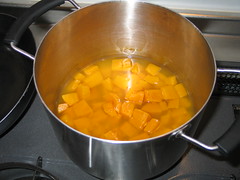
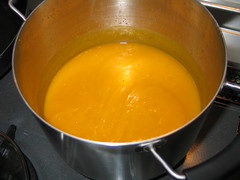
You need a couple of cups of skinned, seeded, coarsely chopped pumpkin, yellow squash, acorn squash, or whatever seems fresh. Add some mild stock to cover this; I used fish stock, which I made from the saury bones. Bring the mix to a rapid boil, cover, and simmer fast for 20-30 minutes or so, until the squash is falling to bits. Puree well (I’m using my new toy, an immersion blender), and strain coarsely in case you missed some stringy bits. Bring to a strong simmer and add a cup of fatty milk or cream and a dash of cayenne, whisk thoroughly, and reduce the heat to a medium simmer. You really should then whisk in ½ cup of crème fraîche, but I haven’t seen it yet in Japan so I’m going to use a small amount of warm, finely-cut brie cheese. Add salt and pepper (preferably white) to taste, and serve. You can keep it warm for quite a while, but do not let it come to the boil or it will probably break.

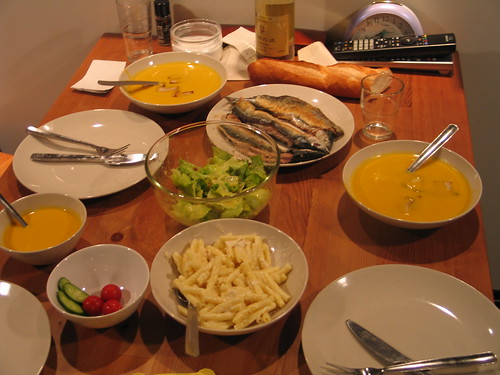
Here’s how dinner came out. The soup in the large bowls is garnished with a little seared sliced mushrooms. The mac and cheese is homemade, but cheese is not readily available in anything resembling quality, so I had to use something labeled "camembert" that tastes like American cheese --- Sam didn't mind. The wine is cheap Euro-plonk from Spain. As you see, I didn't bother with en colère this time (that's where you pull the tail of the fish through the mouth and saute that way), because I'm pretty sure the sanma'd have fallen to bits ; I just floured lightly and seared in a small amount of oil. Tasted good, if a bit bony here and there.

Next time, well, who knows? I'll try to do some restaurant reviews and photos, decent recipes and the like, documentation of my kids eating their way through Kyoto, and of course periodic rambling about Japanese food culture -- and homemaking culture, really, since that's what I'm doing. But I've got no clear plans, exactly. We'll see.

Stumble Upon Toolbar